Showing posts with label tv. Show all posts

27 September 2022

NZ television: the first 25 years

At the weekend I picked up a copy of Robert Boyd-Bell's 1985 book New Zealand Television: The First 25 Years at an op-shop in Featherston (Monsieur Fox, 74 Fox St). It's a fascinating time capsule of the development of TV at a time before the national network was fully commercialised, and when there were still only two nationwide TV channels. (TV3 didn't launch until November 1989).

New Zealand was a late starter in television terms, only implementing network TV in 1960, more than four years after it was introduced in Australia. Governments were wary of the additional cost involved in establishing a new broadcasting network, particularly because the existing radio networks were deemed to be furnishing all the country's mass media requirements in a cost-effective and easily regulated environment. But experimental test screenings led to growing public demand, and in January 1960 the Nash Government announced that TV would be introduced in the four main centres later that year.

Boyd-Bell's book documents the gestation of TV services and summarises the broadcasting highlights of the first 25 years. There are plenty of interesting photos included - below are some highlights of the colour inserts. (All reproduced images are the property of their original owners).   

Selwyn Toogood & the ladies in panel advice show 'Beauty & the Beast'

Scary sci-fi drama 'Under the Mountain', 1981

A shiny Phillip Schofield hosts pop magazine show 'Shazam'

Much-loved telly chefs Hudson & Halls, 1983

John Clarke as Fred Dagg

The 'Spot On' team, 1978

Play School (1972-90)

The Billy T James Show, 1983

See also:
Blog: TV flashback 1966, 1971, 1976, 1981, 1986, 1991

18 May 2021

Corporate censorship in early US television advertising

For the most part [...] the old radio system ruled TV through the mid-fifties, which also meant a continuation of program practices so successful in radio: programming was aimed toward the lowest common denominator; sponsors combed through scripts to delete what they considered to be offending words or characterizations; controversy, either in deal­ing with serious social issues or simply in using black actors, was frowned upon. The latter policy was conducted particularly with an eye toward appeasing Southern stations.

Sponsors paid particular attention to anything they thought would boost the competition.

This often went to ridiculous extremes. Westinghouse at first refused to allow 'Studio One' to broadcast an adaptation of Kipling's 'The Light That Failed,' believing that the show would reflect badly on their bulbs. As Worthington Miner pointed out in his memoirs, West­inghouse became so wound up over the light-bulb issue that it completely overlooked its sponsorship of a homosexual love story!

Chevrolet wouldn't allow a pioneer on one of its shows to 'ford' a river, and Ford wouldn't allow a shot of the New York skyline on a program it sponsored because the Chrys­ler building was shown. Chrysler wouldn't allow Abraham Lincoln's name to be mentioned on a CBS show about the Civil War, while Mars Candy Company objected to a script in which a little girl was given a dollar to buy ice cream and cookies.

On the 'Camel News Caravan,' in an interview with 'Lucky' Luciano, only the mob­ster's first name, Charles, could be used, so viewers would not confuse it with an ad for Lucky Strikes. The word 'lucky' seemed to pose a particular problem for American Tobacco's competitors. Scriptwriters regularly combed through thesaurus to dredge up synonyms like 'fortunate' or 'providential' whenever the forbidden 'L word' popped up. How bad could it get? This bad: even the word 'American' was proscribed on one show.

- Jeff Kisseloff, The Box: An Oral History of Television, 1920-1961, 2013, quoted in DelanceyPlace.com

08 November 2017

Colour separation

John Fortune was once in a TV show with Irene Handl. It involved colour separation, a technique then in its infancy, and the enthusiastic young director thought he should explain the process to Miss Handl at the outset.

Swathed in a fur tippet and carrying at least two Pekingese, the dumpy old lady listened patiently while he embarked on a lecture about electronics. Eventually she interrupts: "Excuse me, dear, but I think you're confusing me with one of those actresses who gives a fuck"

- Alan Bennett, Writing Home (1980 diaries), London, 1994

04 May 2016

Mark Weldon's disastrous tenure

So the unloved chief executive of MediaWorks, Mark Weldon, resigned this morning, presumably having received strong hints from his board to fall on his sword. His departure, coming as it does in the wake of numerous high- and lower-profile staff departures from the company, will not be lamented by most of his employees, who have seen a radical reshaping of the network during Weldon's tenure and the end of many of TV3's long-standing programmes. As Duncan Greive has so clearly spelt out, Weldon never understood what makes the network tick and how that affects its relationship with viewers:

This then, was Weldon’s chief failing: that he didn’t understand either the value of news to TV3, or the importance of relationships within the whole organisation. The channel was always the plucky upstart, its culture the stuff of legend. But as waves of those who had made it so departed, at every level of the business, so that culture eroded even as flash new studios were built and new brands pioneered. And if the public hates your channel for what you’ve done to its longstanding faces, they’re going to struggle to get excited about your reality shows and your radio stations.
Ultimately, TV3's owners run a business and their objective is profit. Weldon's role was clearly to shake up the network quickly for selling on, so the vulture capital fund owners, Oaktree Capital (assets under management: US$96.9 billion), could reap a high return on their investment and move on to their next target. So Weldon's approach involved moving away from costly line items like news and current affairs and instead focusing on low-cost, lowest common denominator reality programming, preferably with plenty of product placement deals to benefit the company's bottom line.

This led to a string of setbacks for TV3 in particular, including the ending of a 25 year run of current affairs programming, the cancelling of John Campbell's highly regarded crusading nightly 7pm show Campbell Live, and last week the shock resignation of popular newsreader Hilary Barry. Weldon's brand relied on fellow traveller Julie Christie's tatty reality programming, which achieves higher profit margins but dilutes the channel's brand to the point where it affects viewer loyalty, with potentially serious long-term effects on the station's viability.

This is because TV3 has until recently held a special position in the small New Zealand television broadcasting sector. The twin TVNZ channels, TV1 and TV2, have since the early 1990s moved so far from their original public service broadcasting roots that they are unrecognisable. They offer a solely commercial mix of programming with almost no public interest content, competing in exactly the same space as the privately owned TV3. But TVNZ retains a strong and loyal viewership amongst conservative older viewers who will never shift networks as long as TV1 news runs at 6pm and Coronation Street appears in some form. The rest homes of New Zealand deliver a guaranteed captive audience to TVNZ nightly, and even the unfeasible approach of using the Mike Hosking as the vanguard of a charm offensive has failed to deter these well-trained eyeballs.

TV3, from the very beginning, was different. Starting out as the anarchic, free-spirited upstart network, it was the home of personable young news teams and the rambunctious, daring Nightline crew. Soon it won viewer loyalty by carving a niche as the privately-owned broadcaster that was simply miles better than its publicly-owned rival, and it became the place where young media wannabes were desperate to work.

Although in the end John Campbell couldn't quite bring in the eyeballs and the associated advertising revenue to sustain his nightly current affairs show, what he did bring to TV3 over many years was the hallmark of journalistic integrity, decency and personality lacking across the dial in the bland and relentlessly uninventive TVNZ. With his show's cancellation and the subsequent shift to a revamped and revitalised Checkpoint programme on Radio New Zealand - which is every bit as excellent as hoped, and fast becoming essential viewing - TV3 squandered its point of difference, both for viewers and for its loyal employees. Many other staff behind the scenes have left too during Weldon's tenure, either having jumped or being pushed in the major restructuring to cut costs.

As Radio New Zealand's Mediawatch presenter Colin Peacock points out, all this bad blood has now come back to haunt Weldon:

Mr Weldon stands accused of trashing the corporate culture - either wilfully or carelessly - that those before him had built up at MediaWorks. This was highlighted by the scrapping of well-regarded current affairs shows such as Campbell Live, and Mr Weldon's hiring of gossip writer Rachel Glucina, just after a serious breach of ethics in her now-notorious "Ponytail-gate" scoop for The New Zealand Herald. 
The long list of former TV3 journalists celebrating his resignation on social media makes it obvious how unpopular he was.
Perhaps Weldon's replacement will be given more leeway to retain some aspects of TV3's distinct culture by adopting a longer-term view. If not, history will record Weldon's disastrous tenure as the end of a remarkable era in New Zealand broadcasting.

See also:
TV: Mastermind & Peter Sinclair, 29 July 2015
TV: Competing in a market of fluff & titillation, 12 November 2014
TV: The remuneration whoopee cushion, 8 February 2013

25 April 2016

TV flashback 1966


Continuing an irregular series examining New Zealand's TV schedules across the years, and sticking with the 15 April date used for the other episodes, it's now time to venture five years further into the past, to the year 1966. New Zealand in 1966 was concerned about its place in the world and fretted about its security. A small contingent of New Zealand soldiers had been serving in Vietnam since 1963, and several letters to the 11-17 April edition of the Listener debated the contents of a recent Compass TV documentary on the communist threat in Asia. The Listener's editorial looked further afield to the UK, worrying that New Zealand's traditional patron was losing its focus on the Commonwealth in favour of the blandishments of Europe and the EEC. Discussing the recent UK general election on 31 March in which Harold Wilson won reelection, the Listener wrote:

At 19 conferences for leaders of the major parties the Commonwealth was not once mentioned. This could have meant that reporters were asking the wrong questions, but a more probable explanation was simply lack of interest ... We shall need what bridges Britain can allow us, and she in some fields will need all that we can send her. Ultimately, however, our future is in that other commonwealth - the wide world itself.
Peter Sinclair, 1966

The letters page includes correspondence from veteran politician and writer John A. Lee, rebutting some points made by another letter-writer on the 1932 Auckland riots (for more information and the text of the letter, see my 2014 blog). And to cap the letters page off on a curmudgeonly note, L.D. Austin of Featherston writes of that bete noire, 'modern music', related to the debut in 1966 of Peter Sinclair's pop show C'mon:


Sir - In your admirable editorial "In the Teenage Groove" you recommend "the search for excellence" and "the raising of standards" as being necessary in the education of adolescents. Excellent advice. But in the same issue of the Listener appears an advertisement introducing a so-called "N.Z. Hit Parade", soliciting votes for a nation-wide poll on favourite "pop" numbers. With respect, I submit that this is calculated to undermine any efforts such as you have put forward so convincingly.
(I wrote about meeting Pete Sinclair back in 1991 here). No doubt to L.D. Austin's disgruntlement, the Listener details the Top 20 singles for the week of 7 April, with a clip-out-and-send poll asking for young readers' favourite five singles, to be posted to their nearest radio station. Here's what the hip young things were grooving to - none of which are by New Zealand artists:


  1. Nancy Sinatra - These Boots are Made for Walkin'
  2. The Beatles - Michelle
  3. Rolling Stones - 19th Nervous Breakdown
  4. Simon & Garfunkel - Sounds of Silence
  5. Herman's Hermits - A Must to Avoid
  6. Gene Pitney - Princess in Rags
  7. Spencer Davis Group - Keep on Running
  8. Dave Clark Five - Over and Over
  9. Searchers - Take Me for What I'm Worth
  10. Seekers - The Carnival is Over
  11. Chris Andrews - To Whom it Concerns
  12. The Beatles - We Can Work it Out
  13. Shadows - Don't Make My Baby Blue
  14. Cliff Richard - Wind Me Up
  15. Paul Revere & the Raiders - Just Like Me
  16. Simon & Garfunkel - Homeward Bound
  17. Barbra Streisand - Second Hand Rose
  18. Mindbenders - A Groovy Kind of Love
  19. Statler Brothers - Flowers on the Wall
  20. Beach Boys - Barbara Ann

Quite a reminder of a golden age of pop music, and a couple of lesser-known artists in there too. English singer Chris Andrews had four UK hits of his own, but was probably better known for writing a string of hits for Sandie Shaw. The Paul Revere number is quite the rocker, if you can get past the silly costumes, and for the Dave Clark Five clip, the dancers seem to be having way more fun than the band. For the uninitiated, the mysterious Flowers on the Wall, apart from its use in Pulp Fiction, is better known to New Zealand audiences of a certain vintage as the instrumental theme from the legendary sheepdog trialling contest A Dog's Show.

Finally, and befitting a nation that still had strong ties to Britain and the monarchy, the Listener's cover story was devoted to the royal visit to New Zealand of the Queen Mother, then aged 65. The state radio network went all out with local radio coverage of the tour, as this published schedule illustrates:

ROYAL VISIT 1966
Broadcast cover of the first two days of the Queen Mother's visit will be: 
Saturday, April 16
10.55am HMY Britannia berths at Bluff, National Programme, 1XN, 2XP, 2XA, 2XN, 3XC, 2ZA, 2XB.
11.30am Official Ceremony of Welcome at Bluff: National Programme, 1XN, 2XP, 2XA, 2XN, 3XC, 2XB, 2ZA.
12.20pm Public welcome at Invercargill, 4YZ.
10.30pm HMY Britannia sails for Dunedin, 4YZ.
Sunday, April 17
10.0am HMY Britannia arrives at Dunedin: 4YA, 4YX, 4ZB.
10.50am The Queen Mother leaves Britannia for First Presbyterian Church, 4YA.
12 noon The Return to Britannia, 4YA.

The TV listings for the single channel broadcasting on 15 April are taken from the Wellington regional service WNTV-1 - New Zealand TV broadcasting wasn't joined in a single national network until 1969. Programming ran from 5pm until around midnight, and was all black-and-white - colour TV broadcasts didn't emerge until the 1974 Commonwealth Games.

WNTV-1, 15 April 1966

5.00pm Canterbury Tales ('From the Court of King Harffa. King Harffa Mo (David Hindlin) and Jester Minute (Don Farr) establish court in a dilapidated castle purchased for 4/9 1/2' (i.e. four shillings, nine and a half pence) (NZBC)
5.32pm Casey Jones (US railroad adventure, 1957-58, 32 episodes, episode 17 'Night Run - A torrential rainstorm forces the Cannonball Express to stop at Valley Junction', originally broadcast in the US on 14 September 1958; here's the opening credits)
5.57pm Headline News & Weather (NZBC)
5.59pm The Stranger (Australian drama, 1964-65, 12 episodes, 'A science fiction serial about three teenagers who investigate the activities of a mysterious stranger. Starring Ron Haddrick, Bill Levis, Janice Dinnen and Michael Thomas'; written by NZ writer G.K. Saunders).
6.27pm Hazel (US sitcom, 1961-66, 154 episodes, 'The Baby Came C.O.D.' - 'Starring Shirley Booth. Hazel and George help an expectant father with his financial difficulties'; s03e09, originally broadcast in the US in colour on 14 November 1963 but shown here in black-and-white; here's the opening credits for all five series).
6.52pm Adventure (UK documentary, 1963, 'When the Sea Ran Dry': 'A tiny British expedition whose encounters, whether with Tuaregs, with strange 'desert Roses', or with the rock paintings of Tassili, were no less rewarding than those of the more spectacular professional explorers'
7.20pm Sports Magazine (NZBC)
7.30pm Weather Forecast (NZBC)
7.33pm NZBC Reports (Film and spoken news) (NZBC)
7.48pm Town and Around ('Local events, views and items of topical interest. Produced by Kevan Moore') (NZBC)
8.05pm Reluctant Bandit (UK thriller, 1965, 5 episodes: 'The Great Attack: A five-part BBC thriller serial, starring William Dexter, William Mervyn and Patricia Haines. Robert has taken the unusual step of forming a Mafia-protected union. Final')
8.40pm The Great Adventure (US historical drama, 1963-64, 26 episodes: 'The Colonel from Connecticut: Adventure stories drawn from American history. Ex-railroad conductor Edwin Drake sacrifices everything he owns in a long, heartbreaking attempt to drill the world's first oil well. Starring Richard Kiley and Maggie McNamarra. Narrated by Russell Johnson'; originally broadcast in the US on 10 January 1964)
9.29pm Science in New Zealand ('A monthly programme introduced by Prof D.W. McKenzie. Produced by Peter Cape. The second of a new series') (NZBC)
9.59pm Cluff (UK drama, 1964-65, 20 episodes, 'The Daughter-in-Law: A BBC detective series based on the novels by Gil North, starring Leslie Sands as Sgt Caleb Cluff. Cluff's approach to crime is largely instinctive and is based on his knowledge of the Yorkshire villagers of Gunnarshaw. Jacob Bateson marries against his father's wishes and financial necessity forces the young couple to return to the family farm'; first broadcast in the UK on 31 August 1964 as part of the first series of Cluff, the entirety of which is missing from the BBC Archives)
10.52pm Late News and Weather (NZBC)
10.58pm Oyster Man ('Christopher Brasher reports from eastern England about a man who started three small industries after the war and is now self-supporting')
11.05pm Ann Veronica (UK historical drama, 1964, 4 episodes, 'Votes for Women - A four-part BBC serial starring Rosemary Nicols and Philip Bond. It is the story of a vivacious and attractive girl who bitterly resents the fact that a woman should be economically dependent on marriage to a man chosen for her. Ann is determined to repay Ramage and sends back half the loan money - all that she has left'; story from the original 1909 novel by H.G. Wells, which included the then-scandalous lines, '"She stood up and held her arms toward him. 'I want you to kiss me,' she said. . . . 'I want you. I want you to be my lover. I want to give myself to you. I want to be whatever I can to you.' She paused for a moment. 'Is that plain?' she asked."').

See also:
TV: Flashback 1971, 1976, 1981, 1986, 1991
History: New Zealand in 1966
History: New Zealand general election, 26 November 1966
History: New Zealand in Vietnam 

29 July 2015

Mastermind & Peter Sinclair

Peter Sinclair (screencap via The Spinoff)
Steve Braunias' column today about the penultimate grand final of the New Zealand edition of Mastermind in 1990 brought back fond memories. I was fortunate to appear in the final series of Mastermind the following year (indeed, I'm fond of claiming my appearance was its death knell) and can endorse the appraisal of the hugely experienced host Peter Sinclair as the consummate professional and just a decent, nice guy. Like the 1990 winner Hamish McDouall (now Deputy Mayor of Wanganui District), I was a relatively young competitor - either 17 or 18 at the time of filming, and from memory I may have been the 2nd youngest competitor in the programme's NZ run. 

It proved surprisingly easy to get onto Mastermind. At the time I was reading anything and everything, which is one of the benefits of doing the first year of a BA degree, so I made up for my lack of experience with a reasonable amount of book-smarts. And I surmised that in a country of three or so million, not many would actually put their hands up to be on Mastermind, which turned out to be accurate. My specialist topic was a series of books I was mad about at the time - the Belgariad fantasy novels by David Eddings. Not high culture by any means, but I knew them back to front, or so I thought.

My first appearance on the programme - also my first appearance on TV in general - went by in quite a daze.  It became obvious that the all-black background was convenient because it meant TVNZ could spend the bare minimum on set-dressing.  I don't think I met Sinclair before the recording, but I knew what to expect and my specialist questions were all straightforward. The general knowledge round wasn't particularly hard either, and I emerged the winner of my heat by quite a decent margin. The main memory of the night is the thickness and orangeness of my caked-on TV makeup, which was required due to my noxious teenage skin, which of course could not be permitted on viewers' primetime screens.

Some months later I returned for the first semifinal with three fellow contestants including, I think, a father and son duo, Olaf Peek and his son, whose name I can't recall. The competition was much keener, and the questions on my books had been toughened up quite a bit. University exams were on at the same time, so I hadn't had time to re-read the the five books before the recording. In the end I came something like 3rd in the semifinal - not good enough to progress to the final - and kicked myself for never having heard of Don McLean's 'Vincent', which was admittedly released two years before I was born.

Afterwards I was able to talk briefly with Sinclair, and he was particularly kind when he saw how disappointed I was. Rather than winning a much-coveted trip to England, it would take me six more years to finally reach London under my own steam. Sinclair revealed that he and the crew had thought I might be able to go on and emulate McDouall's feat of the previous year, which was a very nice thing to say. And I witnessed a moment of quiet dignity too, when some numbskull audience member asked Sinclair if it was alright to have his picture taken in Sinclair's hosting chair in front of the Mastermind sign. Sinclair of course offered to be in the photo too, and the man replied, 'Nah, that's fine'. It may have just been a thoughtless remark but it struck me that Sinclair just smiled and let him get on with it, ignoring the insult. A true gentleman through and through.

[The above text is a lightly edited cross-post of a comment I posted on the Braunias blog]

26 April 2015

Big, biggest, colossalest

Siobhan Sharpe (Jessica Hynes) from the BBC sitcom W1A: 'So what we're talking about here is major brand surgery ... so listen up - we're sitting on three letters here guys, that's like, duh, the raccoon is already in the trash can here guys, and all you gotta do is nail that lid shut. And how we do that is from like June 2015 whatever, we seed the hashtag 'BBC', but it's gonna stand for Big, Biggest, Colossalest. So it's like the biggest name you can have for anything. In the world, ever. M'kay?'


16 January 2015

I live a life of danger for the FBI


Originally recorded by Johnny Rivers in 1966 as the US theme for a British TV series featuring Patrick McGoohan, Devo's version from 1974 was filmed for this clip in May 1976. It formed part of the Devo film The Truth About De-Evolution, which was in effect the band's first music video. The Rivers version is fun too, albeit rather more straightforward.

15 January 2015

What about my crazy surgical options, Dr Spaceman?

TV star Jenna Maroney seeks medical advice from "Doctor" Leo Spaceman (pronounced 'Spachemin') to combat her new-found obesity:

Spaceman (Chris Parnell): Now Jenna, medically speaking, for your height, your weight puts you in what we call "the disgusting range". Fortunately, there are solutions. For example, crystal meth has been shown to be very effective. How important is tooth retention to you?

Jenna: (Jane Krakowski): It's... pretty important. What about my crazy surgical options, Dr Spaceman?

Spaceman: Please: "Doctor" Spaceman is my dad. Call me Leo. And there are some wonderful crazy surgical options. Are you familiar with the Bradshaw Clinic?

Jenna: Am I! That's where the Olsen twins were separated.

Spaceman: I've sent a number of my famous clients there. [Cut to framed portraits of Ashlee Simpson, Kenny Rogers, King Hollywood, Alf, some presumably well-known senator, and the Unabomber]. I can make the call, get you in as soon as possible.

Jenna: Thank you Leo. I can't be on television looking like I just had a baby or something.

Spaceman: This right here is why I got into medicine.

- 30 Rock, 'Jack Gets in the Game', s02e02, originally broadcast 11 October 2007

08 January 2015

Charlie Brooker's 2014 Wipe

Several years ago I attended a BBC TV recording session for Charlie Brooker's 'You Have Been Watching' and found myself in the front row of the audience having to avert my eyes to avoid viewing the trailer for video nasty Human Centipede. (Don't Google it). Brooker is a rare treat in a TV commentator, in that he knows the medium intimately, but unlike most other apparatchiks who buy into the notion that it's all a marvellous realm of tinsel and dreams, he is fully aware that most of what is produced is unbearable crap perpetrated by flagrantly mendacious narcissists. Even when he married the sparklingly Konnie Huq, Brooker failed to lose his mordant, grotesque fascination with picking the scabs off our declining civilisation and holding up the suppurating sores for the camera and the delectation of his relentlessly bleak worldview. (I'm selling this really well!)

His annual gazetteer Wipe programme - the title being derived from his weekly Newswipe half-hour programme - summarise the entire year's media news with a now-traditional lack of reverence for decorum and good taste, but with a healthy contempt for the self-important, puffed-up world of news and current affairs. Plus endlessly entertaining clips of stupid people trying to make instant snow by flinging boiling water into the wintery air and ending up burning themselves and going 'ow-ow-ow-ow!' He also really really doesn't like Pharrell's stupid hat and annoying song. Which I'm delighted to say I'd never heard before watching this programme.

Aside from Brooker's hilariously scabrous commentary, the Wipe also benefits from judiciously selected guest contributors. This year's highlights included a short film by Adam Curtis discussing the modern political management technique of engineering constant chaos and confusion in society as a strategy to derail political opposition to established regimes. The technique has been most successfully applied in Russia, but Curtis makes the case that it has also been successful in Britain - although this is a satirical programme, so you should never take anything strictly at face value.

There's also the recurrent commentary throughout the Wipe from Brooker's regular contributors, 'Philomena Cunk' and 'Barry Shitpeas', whose modus operandi is a level of profound stupidity that is almost operatic in scope. Witness the monologue by Cunk (actor and comedian Diane Morgan) on the ubiquity in 2014 (in Britain, at least) of Messianic comedian and bearded social revolutionary, Russell Brand:

Then he brought out a book called Revolution about how unfair everything is, and so you'd know he meant it, he pulled a serious face on the front. It was about how catapultism is naughty, and how we could build a better world if we were nice to each other instead of spending all our time thinking about coins. He'd talk about how the status quo keeps the working classes enslaved, which I found sort of boring compared to the stuff he used to do about putting his dinkle into granddaughters. What he's saying might actually be stupid, but it's hard to tell because he says it with clever words. [Clip of Brand on Newsnight: 'We don't want pedagogic figures coming in and didactically shouting at us!'] So the only people who can actually tell if he's stupid are clever themselves, and they think everyone's stupid compared to them anyway. Basically, the only way to find out if he's clever or stupid will be to do everything he says, and see if society totally collapses and hundreds of thousands of people die.
For more of this arrant nonsense, see the 2014 Wipe below, as broadcast by the BBC on 30 December. (They seem to make an exception to their no-uploads policy for the Wipe, for some reason).


See also:
Comedy: Charlie Brooker & the Blockheads - Reasons to be Fearful '14
Comedy: The death spiral of news, 17 March 2014
Comedy: "I'm actually an atheist", 7 January 2014

12 November 2014

Competing in a market of fluff and titillation

From an interesting discussion with Russell Brown on 'Media Take' the week before last, on the outsourcing of Maori and Pacific broadcasting from within TVNZ to external providers:

'[These shows] have been around for 30 years. [Like] Tagata Pasifika: there is nothing else on TV for our Pasifika whanau. And Waka Huia and Marae, [they] are the programmes that have documented our histories. We can't compete in a market that's looking for fluff and titillation. There needs to be a place that by purpose and by design records and represents the oral histories, the recorded histories of our people in this country, in a mainstream way. Not everything has to come through Maori TV'.
- Marama Fox MP, 'Media Take', Maori TV, 28 October 2014
I completely agree with Fox - it's vital that Maori stories and culture are shared by dedicated experts to the largest possible audience. But I'd go one step further and point out that the same exposure should be everyone's right in New Zealand, and is what we had via TVNZ until its public service remit was killed off, and which was then extinguished more comprehensively by the closure of public service digital channel TVNZ7. What we have now - a corporate, ad-driven national broadcaster that only serves advertisers, not the public interest, is a ridiculous embarrassment. And as commentator Richard Pamatatau points out in the same programme, it's a broadcaster that increasingly fails to reflect the diverse multicultural reality of modern New Zealand:

'What will happen is that the expertise from inside TVNZ that can correct what will become an increasingly white broadcaster or publisher won't be there. So when TVNZ risks making a mistake around broadcasting something that is connected with the Pacific population, the in-house expertise won't be there, and then it becomes an organisation that is less credible, and it's not best practice. It becomes "the white man's view of the world"'.
- Richard Pamatatau, Pacific Island Media Association, ibid.
See also:
TV: Watching 7 Sharp (so you don't have to), 10 August 2014
TV: Diversifying TV1's schedule, 25 March 2014
TV: TV flashback 1976, 12 February 2014

10 August 2014

Watching Seven Sharp (so you don't have to)


The recent controversy about the appointment of the right-wing TV presenter and talkback host Mike Hosking as the compere for the TVNZ general election debates reminded me that for me, Hosking falls into a category of New Zealand social phenomena that most other people in the country probably know about. I've never heard his radio show because I don't listen to talkback radio, and I've never seen him on TV before. TVNZ's decision to have him host the debate is of course nonsensical from the perspective of someone who wants to hear an intellectually stimulating, free-ranging exchange of views between our would-be elected officials, because only last year he endorsed the Prime Minister's re-election campaign personally ("We have bright prospects for the future, so long as you keep them in Government,'), and is therefore hopelessly compromised.

But Hosking's involvement is a moot point really, because the argument that his conflict of interest disqualifies him from hosting the debate only works if you assume TVNZ operates in the public good and is motivated by the best interest of the New Zealand democratic system. Of course, it doesn't. It only operates to deliver financial return to the Government by selling airtime to advertisers, and anything that gets in the way of that, like journalistic impartiality, is largely irrelevant. In TVNZ's view, the simple equation is: Hosking is the host of our prime-time magazine show, so building his profile is vital, so he must host the debate, whether he'll be good at it or not. Hosking has claimed he'll try to do his best in the role, and that in any case, he's a presenter, not a journalist. Glad that's been cleared up.

In any case, this discussion about Hosking's biases and ability reminded me that while I've always presumed his 7 o'clock show Seven Sharp was rubbish, it was unfair of me to hold this view without ever having seen it. So recently I set the recorder and captured Seven Sharp's output from 28 July to 1 August, and gave them an airing to get a sample of the programme's output. How did it turn out?

Monday

So. The opening credits and synth music are inoffensive and bubbly, as if for a Saturday morning kids show. The fonts used are crayon-like and unintimidating. There are two beaming faces behind a desk, in the now-traditional format of middle-aged male anchor with a younger, heavily-coiffed female sidekick. Hosking's famed midlife-crisis hairdo and outfit tries to pull his image, screaming and kicking, back into his thirties, but no-one's fooled; sidekick Toni Street has a broad grin (well, so would you if you were on telly getting paid wheelbarrows of cash) and the sort of hair only women on telly with professional hair wranglers have. Toni is thirty years old, from the provinces, is sporty, and thanks to Hosking we soon know she drinks gin and orange, which is code for being a bogan. 

Seven Sharp operates on innocuous banter peppered with tiny VT items, as short as possible so they can sometimes fit two tapes into the space between the ad breaks. The first item of the week is a bit of Fair Go advocacy by Heather du Plessis-Allan, who has a lot of names and shares an acronym with both the Hoboken Dart Players Association and the Hellenic Data Protection Authority. She trawls Courtenay Place bars in Wellington, measuring the number of millilitres issued when she orders shots of whisky. Thereby she locks up the viewing loyalty of a nation of shot-drinkers, although its unclear whether the purchased liquid was actually consumer by the journalist during the production of the item. Her Twitter feed does mention testing a few more whiskies with Jacinda Ardern the following week, so perhaps this item was a case of incorporating one's personal interests into one's day job. In his curious accent, Mike offers his views on the economics of drinking spirits: 'People have got money to burn in this country if they're out there buying the nine dollars whiskies and the chips and dips'. Social commentary, that. In any case, have I mentioned that Seven Sharp is brought to you by Rabobank? Which I like to think is a Scottish-Irish corporation: Rab O'Bank. (Thank you). 

The Commonwealth Games are on in Glasgow this week, so there is a brief discussion of New Zealand's cycling progress, but most time is devoted to a Scottish athlete who proposed to his girlfriend at the games. Mike interviews a New Zealand judo organiser, which is a commendable focus on a niche sport until you realise that it was only selected because Mike used to do judo. (He was a white belt, you know. Which is the lowest or second-lowest belt there is in judo.)

A brief and relatively lazy segment follows, which could be titled 'Shit We Found on the Internet'. It includes a Youtube clip of a beach-going Mexican couple whose video selfie near Cancun is disturbed by an impressive lightning strike behind them. Mike and Toni affect bewilderment at the explosion and ask to see it again, and then once more in slo-mo. Yep, lightning is definitely a thing. Then the show proceeds into a trifling glance at current affairs, with a 'body language expert' casting her eye over election billboards of the major candidates. Her verdict? None of the politicians emerge with honours, so instead she picks a mocked-up one showing the Seven Sharp chap interviewing her. Much hilarity ensues, and the point is clearly made that the default setting for Seven Sharp stories is to make the presenter as much a part of the story as possible. Luckily, this wasn't much of a story.

Just before the end credits, it's time for the immediately hilarious editorial section, where Toni and Mike offer their views straight to camera, vox imperator/imperatrix/dei. The only thing missing is an actual wagging finger. Toni provides an update on a child trafficking story, which we all agree is Very Bad Indeed, while Mike has decided that he 'can't see the Conservatives getting over 3%' at the election, which is a rather precise prediction, and would make me wonder what his sources are if 1) he hadn't arrived at the figure whilst interviewing his laptop, and 2) I didn't agree with him.
   
End credits. Toni wears Karen Millen!  What Mike wears is apparently best left uncredited.

Tuesday

This episode kicks off with a piece from a techno-school in Hobsonsville in the Upper Harbour electorate, which mixes gizmo-centric new-fangled pedagogical practice with calling teachers by their first names malarkey. The children interviewed seem to enjoy it, but then who wouldn't enjoy mucking about with robots and watching Youtube clips at break-time? The show leaves us little room for ambiguity by captioning a school spokeswoman as a 'Forward-thinking deputy principal'. Tellingly, and developing a theme that would recur later in the week, there are almost no brown faces on display at this very nice and well-equipped school. The school appears to be an innovative and commendable initiative, but you can't help but wonder why it's happening in a comparatively well-off white-bread area when it could be of so much use in, say, South Auckland or Porirua.

In the grab-bag section Mike and Toni return to the sporting extravaganza in Glasgow, but only to talk about romance, because sport is clearly boring for viewers and advertisers, but anything that leads to shagging is fine. There is also a brief flirt with politics in two micro-items. Lorde's voting drive video targeted at young 'uns is played briefly ('Only 2000 hits', Seven Sharp sniffs), as is a presumably hilarious clip of Hon Judith Collins dancing vigorously at some community event, as only happens in election years. On the latter, Mike remarks 'I'm so impressed'.

After the break, a moderately useful VT item on an arts programme in Nga Wha Prison in Northland (which has two reviews on Google Plus), where wood carving and other art skills are helping to rehabilitate prisoners, or at least keep them occupied. This starts a trend of the week: pretty much the only Maori faces on Seven Sharp this week happen to be prisoners in correctional facilities. Unintentional, no doubt, but rather telling.

To shoe-horn a link for the next item, Mike and Toni are, unfortunately, talking about nudity. It's traditional in these schticks for the talent to hint at a sexual frisson between co-hosts, but this is more or less the only outbreak this week, when Mike remarks to Toni that 'We thought if we got you naked, it might get people tuning in'. To which the correct response is to say, 'F**k off, Mike'. Toni doesn't say this, though. The item is even less impressive than the intro - just a bunch of micro-trailers for a new wave of nude (a.k.a. crap) telly shows from America, for which the inventor of modern onscreen pixellation software has a lot to answer for.

The final VT for the day is a 'health' item about fist-bumping instead of handshaking that is so trivial I can't even be bothered to discuss it. In the editorial outro that follows, Toni praises the integration of para-sports into the Commonwealth Games proper, and Mike offers his wisdom to parents of kids who play sports. Turns out you shouldn't flog the little shits after all.

Wednesday

All through this week the shows have started with a shiny sports trophy on the Seven Sharp desk. (I hadn't mentioned it before now because it's all very inconsequential). This time it's the Melbourne Cup. The presenters promote their own sporting prowess and vow to bring in their best presentation cup from home, thereby leaving the nation gasping with anticipation until the end of the week. Toni will probably win, because she used to keep wicket for Central Districts Women, i.e. has actually played sports properly. Jocularly, Mike refers to Toni as 'the Streetmeister'. I'd like to say that no-one in their right mind uses such feeble and outdated terminology to refer to their colleagues, but I'm probably wrong.

I now detect a pattern in the blink-and-you'll-miss-'em 'news' updates that follow the greetings. There's one actual news item (5 seconds on Gaza!) and two absolutely not-news items, surfing squirrel-style. Can't over-tax the viewers' cerebral cortices, can we?

Item 1 is a Hosking interview about the newly-released Police report on their deeply troubling conduct over the Crewe murders in 1970.  Mike interviews former National right-winger and Police Red Squad member (during the '81 Springbok tour) Ross Meurant, who despite his conservative background is commendably frank about the Police cover-ups and evidence-planting during the investigation. Meurant believes a prima facie corruption case against two officers existed, but was never followed up. Which begs the question (which Hosking doesn't ask) why couldn't Meurant do something about it when he was an MP for nine years? But Meurant does come out with the pithy observation that 'Police should have the proper scrutiny of the courts, not this mongrel Independent Police Complaints Authority'. Hard to argue with that.

For item 2, Toni's linking ability might need some polishing, because all she can come up with is 'Okay, we should probably talk about pigs now'. Must we? The purpose of this story is to show city folk that piglets are cute. Oh so cute! The reporter is delighted at all the pulchritudinous porcines presented. Delighted, I say! It's a 'freedom farm', and the irony is hammered home with sledgehammer subtlety when it is revealed that the pig farm is actually run by Christchurch Prison using inmate labour. What, another Corrections puff-piece in the same week? Anyway, the piggies look very nice and all is sweetness and light until one worker slips in that for their labour the prisoners are paid 40c an hour. Urk! Can't have politics intruding on a feel-good story, can we? Virtual slave labour wages, no thank you. Again, more Maori faces onscreen as the prisoners are interviewed. Well, the bottom half of their faces anyway, so they can't be recognised, except to anyone who's ever met them more than once.  

Item 3 is a stilted video link-up with Glasgow to speak to gold-medal-winning swimmer Sophie Pascoe. The long satellite delay doesn't help, and nor does Pascoe's ultra-conservative media training, which prevents her saying anything remotely controversial and also anything remotely interesting, apart from revealing that she's 'fighting a wee infection'. Which is a bit personal, if you ask me. Still, we wish her urinary tract well because we like it when people win shiny things overseas.

In a link, Mike disses his own son for getting aspects of an inconsequential school haircut rules story wrong, and then we proceed to a follow-up piece on a Nelson pensioner whose flat has been insulated thanks to TV exposure-garnered charity. We like this because chilly pensioners deserve our charity, except the ones who aren't on television.

In the editorial outro, Toni (who always has to go first, junior partner and all) promotes a local lad who dresses up as (mostly female?) celebs to garner Youtube hits. Mike offers his take on the Novopay teacher salary system scandal, briefly criticising the 'accident prone' Ministers Hekia Parata and Craig Foss but then notes that 'Good old Mr Fixit Stephen Joyce was rolled out' to fix the problem, or not as the case may be. To wrap up, Mike provides his only profoundly stupid statement of the week, when he reckons it might be teachers' own fault for having such a complicated pay system. Only one outburst of imbecility in a week is fairly good going for a talkback host promoted to live primetime TV.

Thursday 

Mike reveals his age by asking the rhetorical opening question, 'who doesn't want to see Kenny Rogers?' Kenny Rogers is 75. Toni ribs Mike for also extolling the virtue of Dolly Parton in an earlier show. She is not, unfortunately, arguing that country music is shit; rather, she is lampooning Hosking's fuddy-duddy tastes. Hosking's wikipedia page lists his birthdate as 'born c. 1965'.

VT item 1 for the day is a trip to Sydney to interview the young New Zealand jockey James McDonald who is only in his early twenties but drives a new BMW 428 Sport. (This is apparently a good thing). More importantly, he wins a jockey championship, which is no mean feat in the competitive Sydney racing circuit. The main take home message from this item is that the winter weather in Sydney is a piece of piss, which is presumably why the reporter wangled a flight budget to get over there.

Item 2 is an interview with a proper politician, sort of. Georgina Beyer was a Labour list MP for eight years until 2007, and was the world's first openly transsexual MP. Now she's standing for the Internet Mana Party, although she's not in the 15-strong party list so stands little chance of being elected. She shows the cameras her regular regime of dialysis for her kidney disease, discusses the privations of being an ex-MP on the dole, and reserves a choice barb for the impertinent reporter's question of why she'd want to go through the whole political circus once more.

After a recurring theme of Commonwealth Games photobombing (this time, the Duke of Cambridge), item 3 is a cook-off following the rules of a new cookbook designed to show how people could live on a mere $2.25 a day. It's all in a good cause, and celebrity chef Annabel Langbein pops along to judge a cook-off between two Seven Sharp presenters. Langbein utters the immortal line, 'Imagine living on $2.25 a day when my latte costs $4.50', which is a reminder of how very, very middle class Seven Sharp is. The $2.25 campaign is highlighting the challenges of poverty in New Zealand, but Langbein and the reporters spend most of the clip laughing uproariously. It's all so much fun pretending to be poor! But at least they've mentioned the concept that people in the real world might actually only have that much money - half a latte, OMG! - to spend on food per day. Neither reporter wins the cook-off, but later it is revealed that the perma-chuckling Matt Chisholm has cheated, so he is disqualified. Someone cut off his bennie immediately!

Toni's editorial piece is about new breastfeeding research, and she as a new mother has Views, which she Expresses. I could probably work in a joke about expressing milk there, if I was interested enough. Mike lauds legislative changes benefiting war veterans, because they 'can't get enough support', which only goes to show that there are plenty of beneficiaries that conservatives actually do like. 

Friday 

The much awaited cup-off between Mike and Toni kicks off the final episode of the week with a fizzer. Toni's two cups are for small sporting achievements, but Mike's minuscule trophy is from his own children for being a great dad. Although they're unlikely to be an unbiased sample, I would've thought. And as Toni points out, the metal is suspiciously clean, leading one to wonder if Mike dashed out earlier in the week to get the thing made for himself. The one serious, two silly format for news clips follows: Gaza! Bloom vs Bieber! A Katy Perry video is made by a New Zealander! My IQ is draining away, ever so slowly.

Another limp intro from Toni: 'We should probably talk about Ebola'. Should we really? They manage to shoehorn in a clip from Contagion, just in case you'd forgotten what a fictitious pandemic looks like. Mike talks to a health expert in Washington DC to ask if we should all panic and begin to eye up frail and youthful relatives for the inevitable descent into organised cannibalism. The answer is no, it turns out.

The penultimate item of the week (although Seven Sharp would probably never use the word 'penultimate') is about a reporter. Wait, there's more - it's about a reporter accompanying the Bledisloe Cup on a plane to Sydney. That's all it is. I can't remember if it was the same reporter who interviewed James McDonald on Thursday's programme because all the reporters tend to merge into one amorphous blob of self-promotion, but let's assume it was. He is a nincompoop who knocks the venerable Cup loudly while carrying it down the plane aisle.

Seven Sharp then takes a brief detour to the mean streets of Wellington's expensive suburb of Seatoun, where the local decile 10 primary school is kindly participating in a scheme where cute little children wear earmuffs to remind them that deaf people exist, and so their teachers can practice swearing at them without the kids hearing.

The final VT item of the week is by Seven Sharp creative producer Dean Butler, formerly of the excellent Funny Business troupe - here he is looking young, with Lucy Lawless. Dean is assigned to run the Skytower challenge with a young chap running for leukaemia research. Not at all predictably, the relatively 'mature' Butler opts for the lift instead.

To close the week, Mike goes on a rambling critique of politicians who have chosen to go teetotal for the election campaign. He extols the virtue of a glass or three of vino with such vigour the viewer might stop to ponder if he's over-keen to get to after work drinkies. The production crew 'surprise' Mike with a clip of him at his studio desk 'singing' 'Hey Mr Tambourine Man' badly. It's not particularly amusing, but it does occupy 10 seconds of airtime, so it's a win in production terms.

Verdict

Now that I've finally seen Seven Sharp I'm pleased in a way that Mike Hosking wasn't particularly disagreeable. Apart from his numbskull comment about teacher salaries, he didn't say anything remotely offensive in the week I watched. His sidekick Toni Street is, likewise, blandly inoffensive. The levels of perkiness and cheer in the show are in direct opposition to the levels of actual information imparted to the viewer, but realistically Seven Sharp is not a current affairs programme. It is a magazine programme designed to attract high enough ratings to bridge the gap between the news hour and the primetime scheduling that follows. That's all it's there for, and it does that job pretty well. Certainly, the service Seven Sharp offers to its advertisers is unparalleled. In a commercial half-hour there is under 22 minutes of actual content; more than a quarter of its running time is advertisements. Much of its screen time is devoted to bigging up the 'personalities' of its reporters, who must by law be seen to be good keen jokers and sheilas, constantly on the verge of a massive belly-laugh which is ostensibly about the story at hand, but more likely simply a reflection on the wondrous affirmation that comes from knowing you're on the telly, and people who are too lazy or set in their ways to change the channel will therefore recognise you in Countdown.

Seven Sharp's pursuit of advertising-driven ratings is a relentlessly middle-class affair, so many aspects of New Zealand life are ignored. Despite this, Seven Sharp is mostly harmless, a tepid bath of banal trivia designed to numb the brain and pass the time until the sweet release of death. But if this is what many New Zealanders are spending their precious time watching, you have to ask how our collective standards slipped this low.

See also:
TV: TV flashback 1971, 10 April 2014
TV: The remuneration whoopee cushion, 8 February 2013
TV: Saving appearances, 22 October 2012

06 August 2014

The legacy of Mary Whitehouse

From the end credits of the 2008 telemovie Filth: The Mary Whitehouse Story, which features Julie Walters in the title role, the final title card details one of Whitehouse's 'victories' over the permissive BBC in 1972:


I was planning to embed the actual clip - from the post-Xmas episode of Top of the Pops on 28 December 1972 - but only until I watched it and realised the bell-related illustrations were provided by a sketching Rolf Harris. So maybe not. To be honest, it is a dreadful song too. And it's definitely about a penis.

10 July 2014

Fresh Meat

On my recent visit to England my sister introduced me to the excellent Channel 4 sitcom Fresh Meat, which started in 2011 and follows the lives of six undergraduate students flatting together while they pursue their university studies in Manchester. It's by Jesse Armstrong and Sam Bain, the creators of the long-running and much-loved sitcom Peep Show, and features a talented collection of young actors, many of whom are experienced performers. The material is genuinely funny, harking back to the heyday of The Young Ones, but the acting ability of the cast is also a huge asset, because it's always challenging to play comedic scenes to full effect. There are six core cast members in the first series:

Kingsley (Joe Thomas, The Inbetweeners): Perhaps the most 'normal' housemate, apart from the lamentable soul patch. Is hopelessly in love with flatmate Josie but appears powerless to break up with his actual girlfriend, Josie's mate Heather.

Josie (Kimberley Nixon, Cranford, Easy Virtue): Welsh dentistry student who appears hopelessly in love with housemate Kingsley but who repeatedly fails to break up with her boyfriend / fiance back in Cardiff. He's a heating engineer, you know. Josie has a bit of a rough time in series 2, what with the whole leaving the keys in the door and getting the house burgled.

J.P. (Jack Whitehall, Bad Education): Somewhat posh comedian Whitehall plays the out-and-out toff J.P., an outrageously self-entitled big-head with major bedroom ambitions that unsurprisingly prove fruitless. Usually. An expert on life in the regions.

Oregon (Charlotte Ritchie): Reinventing herself at university, Oregon fancies herself the worldly-wise campus sophisticate, which works out fine as long as the housemates don't discover the car her mum and dad bought her, that her real name isn't Oregon, or the fact that she's shagging her English professor.

Howard (Greg McHugh, Gary: Tank Commander): Socially maladroit Scottish geology student Howard is a bit older than the others, but absolutely no wiser. Is always irked when people assume he knows Tolkien back to front. Famed for his legendarily poor dress sense.

Vod (Zawe Ashton, Case Histories): The most streetwise and savvy housemate, Vod (a.k.a. Violet) is the type of cool that Oregon has always wanted to be. She takes loads of drugs, drinks and swears like a navvy, and pays little attention in class. The drug intake becomes a bit of a problem when Vod has to take a urine test to preserve her lifeline, the RAF Bursary; she has to borrow some of Josie's supposedly drug-free wee, which leads to the following scene in the testing clinic - one of my favourites from series 2:

Vod's test results

Vod (Zawe Ashton) at the clinic

VOD: (Enters) Er, Violet Nordstrom, here for my test results.

NURSE: There you go.

VOD: (Reads) Hang on, what's this?

NURSE: It's beta blockers.

VOD: Beta blockers? And I'm on them for...?

NURSE: Stress, and anxiety.

VOD: Oh yeah, I forgot I was on those. Obviously work then!  Heh. If I was to stop taking them, which I can do very very easily, can I do a quick re-test?

NURSE: The results have already been sent off I'm afraid - to the RAF, is it?

VOD: Oh come on, you can't do that! What about patient confidentiality? 

NURSE: Drugs tests can't be completely confidential. Somebody's got to see the results, otherwise there'd be no point doing them.

VOD: Ohh, they're gonna take my money away... (Angry) What am I gonna do without my money - sell my fuckin' kidneys?  You'd like that wouldn't you?!

NURSE: I don't think those beta blockers are working for you.

VOD: I'm not taking the beta blockers! It's not my urine; I couldn't give you my urine because I smoke absolutely tons of weed. 

NURSE: (Writes on Vod's file)

VOD: Don't write that down, it's confidential! I know I shouted it, but I shouted it in confidence!

24 June 2014

The Grand Designs Theme Song

David O'Doherty's Grand Designs Theme Song:

Punters: 'Kevin, we want a huge sitting room so we can have all of our friends over for parties'

Kevin McCloud: 'Yeah, good luck with anyone ever visiting you there - there's a reason the land was so cheap: "only 60 miles from Plymouth". I hate your stupid house, it looks like a Tesco Extra'.


[Apols for recording's low audio volume]

See also:
ComedyDOD on NTN, 10 January 2013
Comedy: David O'Doherty Is Looking Up, 5 May 2012
Comedy: David O'Doherty - Shakira (2012, NSFW-L)

13 May 2014

The Joan Callamezzo school of local broadcasting excellence

Joan Callamezzo (entering TV studio): 
All right, let's burn this candle!

Leslie Knope
Joan, if we could just have a moment? We need to, ah, get ready.

Joan Callamezzo
Oh no no, we gotta go. Yeah, the uppers are kicking in, just took some 'ludes to smooth them out, so I'm right in that sweet spot. We've got about twenty minutes before I either get really tired or really horny. So let's roll!

- Parks & Recreation, s06e14, 2014

See also:
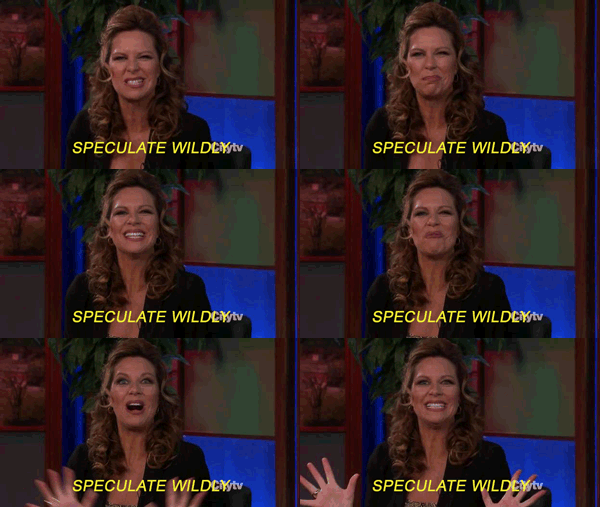
TV: Joan Callamezzo - Speculate wildly! (gif)
TV: Diversifying TV1's schedule, 25 March 2014
TV: 8-bit Freaks & Geeks, 7 October 2013

10 April 2014

TV flashback 1971


In an ever-expanding quest to tell the story of New Zealand TV-watching over the years, our next instalment of viewing summaries takes us to the night of Thursday, 15 April 1971. This takes us closer than ever to the birth of television in New Zealand - which, younger types should be reminded, only started in 1960. In 1971 New Zealand only had a single state-owned TV channel; TV2 did not emerge until 1975.

Moreover, the one channel being broadcast in 1971 was not a national network. For almost all of the first decade of TV broadcasting in New Zealand programming was delivered locally through four separate regional broadcasters (one in each of the four main centres) until the nationally networked New Zealand Broadcasting Corporation (NZBC) was formed in 1969. Until then programming would often differ between regions, and when a programme was scheduled across all four regions it would generally be playing a different episode of the series in each region on the same night. Presumably New Zealand bought the rights to an overseas series once, and then each region would screen it in turns - the tape would be sent from Auckland to Wellington for the next week's broadcast, then on to Christchurch for the following week, and so on.

Part of the challenge of this piecemeal approach to broadcasting was that it was hard to respond to events of immediate national importance, like the 1971 guilty verdict for Arthur Allan Thomas, who was found guilty for the first time for the Crewe murders. (He would not be acquitted until 1979). One key example of considerable historical importance is the sinking of the Wahine on this day 46 years ago in 1968. Wikipedia reports that while the two North Island stations carried up-to-date footage of the transport disaster, the two South Island stations had to rely on distinctly unorthodox news-gathering methods:
The most notable example of the unlinked facilities was when the inter-island ferry TEV Wahine sank in Wellington Harbour on 10 April 1968 - newscasts of the disaster had to be transmitted over Post Office lines by WNTV1 to AKTV2 in Auckland. However, due to the storm disrupting both shipping and flights for a further 24 hours, the first video of the sinking crossed Cook Strait via regular transmissions from WNTV1 and was received on a privately owned television set in Blenheim, at the top of the South Island some 80 km line-of-sight distance from Wellington. A Blenheim based news reporter's film camera was pointed at the television, then the exposed film was rushed by road to Christchurch, developed and transmitted over CHTV3, concurrently sent further south to DNTV2 for transmission there via a coax cable link. Interestingly, this Blenheim film appears to be the only surviving footage of the first day, and it shows part of the television set that the camera was pointed at.
The edition of the Listener containing this week's TV listings (price: 12 cents) has a cover story on the financial woes affecting the farming sector, 'How are they doing down on the farm?' The editorial page contains an essay by Alexander MacLeod on overcrowding and poor conditions at the even-then antiquated Mt Eden Prison in Auckland, which argues that 'There are people in Mt Eden, and we debase our lives as well as theirs in keeping them in conditions that should not be tolerated by a society pleased to describe itself as prosperous and enlightened'.

The Listener's TV listings commence with a handy four by seven grid, showing the three key programmes on in primetime in each broadcasting region, for each night of the week. For Thursday 15 April the three main programmes are It Takes A Thief, Gallery and Never Mind The Quality, Feel The Width. The schedules are also odd-looking to modern eyes because New Zealand TV had yet to work out a compromise between the length of New Zealand and British programmes and the shorter, advertising-packed American shows. Instead, primetime shows commenced at such hard-to-remember times as 8.16pm, 9.14pm and 10.36pm. But then I suppose part of the importance of consistent start and finish times for programmes is if you're hoping to switch between channels to maximise your viewing options; having only one channel means you're either watching the one channel, or you're not.

Let's examine the Thursday listings for Northern Television, Auckland's station, to get an idea of what was on offer in 1971. Broadcasts commenced at 2pm, and closedown was around midnight.

NORTHERN TELEVISION - 15 April 1971

2.00pm Headline News
2.30pm On Camera
2.46pm Cheyenne (Western, 1955-63, 108 episodes, s05e03 'Road to Three Graves' from 1960)
3.33pm Bewitched (Comedy, 1964-72, 254 episodes, s05e18 'Samantha the Bard' from Jan 1969)
3.58pm Cesar's World ('Travel: The jungle stronghold of New Guinea's newly discovered Stone Age warriors', hosted by Cesar Romero)
4.26pm The Wooden Tops (BBC puppet show, 1955-57, 48 episodes)
4.40pm Peter (Cartoon: 'Peter & the Robot Dog')
4.45pm The Space Varmint (Cartoon, perhaps from The Deputy Dawg Show?)
4.50pm The Roadrunner Show (Cartoon: Featuring the Roadrunner, Tweety, and Moustaken Identity')
5.11pm Zorro (Adventure, 1957-59, 82 episodes, s01e36 'The Sergeant Regrets' from 1958)
5.39pm Headline News & Weather
5.42pm This Week in Britain
5.47pm The Johnny Cash Show (Variety, 1969-71, 58 episodes, s01e15 'With guests Phil Harris, Bobbi Martin, Roy Orbison, the Creedence Clearwater Revival' - clip from this 1969 episode of Martin singing 'Your Cheatin' Heart')
6.40pm Gardening ('With Reg Chibnall')
7.00pm Network News
7.20pm Weather (and) This Day
7.46pm Coronation Street
8.16pm It Takes A Thief (Adventure, 1968-70, 65 episodes, s03e21 'The Suzie Simone Caper' from Mar 1970, featuring Robert Wagner & Susan Saint James. Plot: 'A Nazi diary reveals that a painting by Matisse has a hidden list of Nazi war criminals. Wally calls Al to steal the painting, which is protected by a sophisticated security system')
9.12pm Newsbrief
9.14pm Gallery (Current Affairs)
9.42pm Ironside (Detective, 1967-75, 199 episodes, s01e27 'The Due Process of the Law' from Mar 1968, with Raymond Burr, plus David Carradine as Pogo Weems)
10.36pm Never Mind The Quality - Feel The Width (ITV comedy, 1967-71, 41 episodes, s02e05 'Hello Mother, Hello Father' from Sept 1968 - 'Jewish Manny Cohen and Catholic Patrick Kelly run a small tailoring establishment in London's East End, and are always arguing about religion')
11.50pm Late News & Weather

The relative importance of television and radio in 1971 is notable in the space afforded to radio programme guides in the Listener, with two full pages devoted to each day's audio broadcasts, and separate listings for the National Programme, the YC Programme (classical music) and the commercial networks like Wellington's 2ZB (on 980kHz).

Contemporary music gets a look-in in a small singles chart feature, the 'Pop-o-meter', with the complicated reminder to 'Listen to Peter Sinclair's "Hit Wave!" on Thursday, April 15, at 7.2pm, on 1ZB, 2ZB, 3ZB, 4ZB, 1ZH, 1ZN, 1ZC, 1ZD, 2ZC, 2ZA, 2ZG, 2ZP, 2ZW, 3ZC and 4ZA. Saturday, April 16 [sic.] at 7.2pm, on 2ZN and 2ZD'. Here for posterity are the top 20 singles in New Zealand broadcast on 1 April 1971 - with only one (number 16) by a New Zealand artist. My favourite is definitely number 20 - with George running a close second!


  1. Lynn Anderson - Rose Garden
  2. Mixtures - Pushbike Song
  3. Hollies - Too Young To Be Married
  4. Creedence Clearwater Revival - Have You Seen The Rain
  5. Clive Dunn - Grandad
  6. Kinks - Apeman
  7. Mike Curb Congregation - Burning Bridges
  8. Nitty Gritty Dirt Band - Mr Bojangles
  9. Judy Collins - Amazing Grace
  10. Tom Jones - She's A Lady
  11. Freda Payne - Band of Gold
  12. George Harrison - What is Life
  13. Ray Stevens - Bridget the Midget
  14. Dawn - Knock Three Times
  15. Dusk - Angel Baby
  16. Hogsnort Rupert - Aunty Alice
  17. Osmonds - One Bad Apple
  18. Carpenters - For All We Know
  19. Johnny Johnson & the Bandwagon - Blame It on the Pony Express
  20. Mike Nesmith & the First National Band - Silver Moon 

Finally, there's not many garish photo-laden articles in this Listener, which was a text-heavy production back in 1971. But there is a stunning fashion offering near the back for 'Nightwear with flair' - three spiffing Bri-Nylon nightgowns. Settle, gentlemen!

See also:
TV: Flashback 1976, 1981, 1986, 1991
History: 1971 in New Zealand
Music: Neil Young 1971 (BBC 28 min live set)