Showing posts with label france. Show all posts

24 June 2026

Brassaï's Parisian night photography

Here is Brassaï himself, towards the end of his life [in a 1976 interview with Claude Bonnefoy], describing one of his night-time expeditions in the early 1930s: 'I used to spend whole nights beside the canal, waiting for the right moment to take the shot, or in other words for a little fog to soften the lights. Often the hirondelles, the policemen on bikes, seeing a man squatting down would stop and ask me: "What are you up to?" And I'd say: "I've come to take a photo." At two in the morning, that seemed like an odd thing to do. So, I'd have a couple of prints on me so I could show them what it was possible to achieve at night. Then the ones that liked taking pictures would ask me for advice. I explained to them that I had several exposure times - the "Gauloise exposure", in other words the time it took to smoke a Gauloise, and the "Boyard exposure", which was about twice as long. This airy description, long after the event in question, contrasts with remarks made by Brassaï during the 1930s when he referred to 'a period of endless experiments with developers and exposure times', which were probably closer to the truth. The table of exposure times, reproduced at the back of Camera in Paris, shows that far from being a mechanical and repetitive practice the calculations involved a number of parameters, including natural lighting conditions and supplementary light sources. The exposure time could be anything from a fraction of a second to ten minutes or longer: 1/50 of a second for a photograph taken using flash ('14 July, Place de la Bastille'; 'Parisian cats'), one minute without supplementary light ('A carriage in front of "Le Dôme""), ten minutes for a Seine embankment shrouded in fog, or a panoramic view taken from one of the towers of Notre-Dame.

- Sylvie Aubenas & Quentin Bajac, Brassaï: Paris Nocturne, London, 2013, p.196-98.

22 December 2022

Quelle vibration de s’envoyer sur le paillasson

Thursday music corner: Plastic Bertrand (b. Roger François Jouret, 1954) is a Belgian musician and TV presenter who was catapulted to fame thanks to his 1977 (mostly) French-language single Ça Plane Pour Moi, which exhibits boisterous and perhaps semi-satirical punk-pop energy. The single topped the pop charts in France and Switzerland, hit the top five in Australia, Ireland, the Netherlands, Quebec and the Walloon region of Belgium, and reached the top 10 in the UK, Germany and New Zealand. The 1978 album that included the single, An 1, reached number 2 in the French album charts, and number 7 in Quebec. The song's title is an expression that translates as 'Everything's gliding for me'. Most of its lyrics, both French and English, are pure nonsense.

The musical backing track that was used to record Ça Plane Pour Moi was also used in a contemporary single recorded by English punk / new wave band Elton Motello under the title Jet Boy, Jet Girl. While this was released before Ça Plane Pour Moi and managed to reach the top 40 in Australia, it is now mainly remembered for the cover recording of it by Captain Sensible & the Softies, a side project during a hiatus for the Damned. The recording featured on a 1981 Damned best-of album

In 2010 Bertrand admitted that he didn't perform any of the vocals on his first four albums, from An 1 to 1981's Plastiquez vos baffles. The songwriter and producer of Ça Plane Pour Moi, Lou Deprijck, was the actual vocalist.

Plastic Bertrand - Ça Plane Pour Moi (1977)

29 March 2022

Charlemagne's passion for education

[Holy Roman Emperor Charlemagne] borrowed from Roman architecture in the design of churches and palaces such as his main palace at Aachen. Mindful of the Byzantine ban on icon painting currently in force, he promoted representational Christian art through frescoes, the first Christian sculpture, and above all the production of illuminated manuscripts containing realistic depictions of Bible stories.

This touched Charlemagne's foremost concern: education. Low rates of literacy plus a fragmentation of Latin into regional dialects in the centuries following the fall of Rome created problems both for the spread of church teaching and the administration of an empire. Medieval Latin needed to be standardised into a common language for western Europe.

So to Aachen Charlemagne brought scholars from across western Europe. He funded the copying of all surviving Latin texts and the development of monasteries as centers of learning. The driving intellectual force behind Charlemagne's program was Alcuin of York, adviser at Charlemagne's court, then abbot at the monastery of Tours, which he made the foremost training ground for the clergy. Abbey schools such as Tours were not oases of contemplation but engines disseminating Christian learning to the reaches of the empire, and with this came a newly uniform Latin as lingua franca for Europe's educated classes, together with a new and quicker way writing it down using lowercase letters - the way the words are printed in this book.

- Peter Davidson, Atlas of Empires, Chichester, 2018, p.85

See also:
Blog: Precious vessels, 28 February 2011
Blog96 hours in the Eternal City, 16 October 2010
Blog: Popes & anti-popes, 5 November 2009

30 December 2021

Du venin qui me fait mal au cœur

Thursday music corner: French avant-garde pop duo Les Rita Mitsouko burst onto their national pop scene in 1985 with their number 2 single Marcia Baila, the video for which featured exemplary 1980s choreography and a myriad of stunning costumes from Jean-Paul Gaultier. Their stylish, jagged 1980s art-pop was augmented by another impressive video for 1986’s hook-laden single C'est comme ça ('It's like that'), which later won Music Video of the Year for director Jean-Baptiste Mondino at the Victoires de la Musique. (Mondino's other well-known music videos include Don Henley's Boys of Summer, Open Your Heart by Madonna, and Neneh Cherry's Manchild). C'est comme ça was the second single from their second album, The No Comprendo, which was recorded with legendary producer Tony Visconti in both London and Paris. It reached number 10 in the French charts. Les Rita Mitsouko played together until the death from cancer of member Fred Chichin in 2007; his partner Catherine Ringer then continued with a solo career.

Les Rita Mitsouko – C'est comme ça (1986)

22 July 2021

On prétend que nous tuons de sang-froid

Thursday music corner: A star collaboration between stratospherically famous former lovers Serge Gainsbourg and Brigitte Bardot, this 1968 single indulged Gainsbourg’s fascination with American pop culture, specifically the 1967 new-wave cinema classic Bonnie & Clyde featuring Warren Beatty and Faye Dunaway. It was released on two albums in 1968: Gainsbourg's Bardot-referencing Initials B.B., and Gainsbourg and Bardot's album Bonnie and Clyde. Despite this performance with Bardot, by 1968 Gainsbourg was actually romantically associated with English singer and actress Jane Birkin, with whom he recorded the scandalous chart-topper ‘Je t’aime… moi non-plus’, after the then-married Bardot refused to let her recorded version of the song be issued. Gainsbourg, who smoked five packs of unfiltered Gitane cigarettes a day, died in 1991 aged 62. Bardot, now aged 86, is a prominent animal rights activist.

Serge Gainsbourg & Brigitte Bardot – Bonnie and Clyde (1968)


See also:
Blog: Not the swiftest of creatures, 6 January 2018
Music: Le cheveux dans le vent, 13 November 2015
Blog: City of lights, 20 April 2009

04 December 2020

Cour des Miracles

The name of the rue de la Grande-Truanderie (Great Scam) refers to one of the Paris's 12 cours des Miracles, so called because when the most severely crippled beggars returned there at the end of each working day, they suddenly found themselves cured, lively, and nimble. Each had their specialty: the francs-mitoux pretended to faint at street corners, the piètres hauled themselves about on crutches, the coquillards claimed to be pilgrims in need, the sabouleux were phony paralytics or epileptics, the rifodés crawled on deformed limbs, the mercandiers affected to be war victims, and so on. They had laws, a language, and a leader called Le Ragot (today, slang for gossip), who was succeeded during the reign of François I by Le Grand Coësre. Every night, the beggars gave their chief a percentage of their gains and then spent the rest on a feast, since their law required them to keep nothing for the next day, but eat, drink, and be merry until all their money was gone. Towns within the town, the cours des Miracles had as many as 40,000 inhabitants in 1560. The Police Lieutenant La Reynie cleared them in 1667.

- Dominique Lesbros, Curiosities of Paris, New York, 2017, p.69

See also:
History: Paris chose to be self-centred, 1 October 2016
Books: Hemingway starts his day, 30 April 2016

05 June 2020

The siege-breaking balloons of Paris

Important to military aviation in Europe was the founding, in 1870, of lighter-than-air detachments within the Prussian Army. Assisted in their creation by Englishman Henry Coxwell, two Luftschiffer (airship) detachments were used immediately for service during the Franco-Prussian War of 1870-71. However, it was the defenders of besieged Paris that history most remembers.

Cut off from outside help by Prussian forces, the Parisians made use of six balloons held within the city to fly out despatches, often under groundfire, the first by Jules Durouf on 23 September 1870 rising over Prussian lines and on to Evreux. Thereafter, a truly remarkable manufacturing programme was started in Paris, using railway stations and other large buildings to assemble additional craft, with gas coming from the Villette works. By 28 January 1871 a total of 66 balloons had left the city, carrying more than one hundred persons, some three million letters and carrier pigeons. Of these, two are thought to have been hit by groundfire from Prussian guns and seven drifted in the wrong direction. The escape of pigeons had been a vital element of the operation, as chemist Barreswil invented microphotography in October 1870 to allow the birds to return to Paris carrying messages, with the first flying from Tours to Paris on 18 November.

- Michael JH Taylor, Aviators: a History in Photographs, London, 2003, p.89-90.

See also:
History: The last grand night ascent at Vauxhall, 30 September 2010
History: Le Bourget Air & Space Museum, 18 March 2011
History: MOTAT 2, 3 April 2013

06 January 2018

Not the swiftest of creatures

Full-page ad for the Citroen 2CV in Private Eye magazine no.609, published 19 April 1985, with a listed purchase price of £2774. The 2CV was manufactured from 1948 to 1990.


See also:
Motoring: Wellington's British cars, 25 February 2017
Motoring: Mad Lancias of Verona, 19 July 2015
Motoring: Te Awanga British Car Museum, 28 October 2014
Motoring: National Automobile Museum of Tasmania, 7 December 2013

30 November 2016

The Feast of Fools

For most of the year [medieval Christianity] preached solemnity, order, restraint, fellowship, earnestness, a love of God and sexual decorum, and then on New Year's Eve it opened the locks on the collective psyche and unleashed the festum fatuorum, the Feast of Fools. For four days, the world was turned on its head: members of the clergy would play dice on top of the altar, bray like donkeys instead of saying 'Amen', engage in drinking competitions in the nave, fart in accompaniment to the Ave Maria and deliver spoof sermons based on parodies of the gospels (the Gospel according to the Chicken's Arse, the Gospel according to Luke's Toenail). After drinking tankards of ale, they would hold their holy books upside down, address prayers to vegetables and urinate out of bell towers. They 'married' donkeys, tied giant woollen penises to their tunics and endeavoured to have sex with anyone of any gender who would have them.

But none of this was considered just a joke. It was sacred, a parodia sacra, designed to ensure that all the rest of the year things would remain the right way up. In 1445, the Paris Faculty of Theology explained to the bishops of France that the Feast of Fools was a necessary event in the Christian calendar, 'in order that foolishness, which is our second nature and is inherent in man, can freely spend itself at least once a year. Wine barrels burst if from time to time we do not open them and let in some air. All of us men are barrels poorly put together, and this is why we permit folly on certain days: so that we may in the end return with greater zeal to the service of God'.

- Alain de Botton, Religion for Atheists, London, 2012, p.63-5.

See also:
France: Paris chose to be self-centred, 1 October 2016
France: The Paris correspondent starts his day, 30 April 2016
France: City of Lights, 20 April 2009

01 October 2016

Paris chose to be self-centred

Writer Vincent Cronin, on pre-World War 2 Paris' predisposition to misread the diplomatic climate of Europe:

'Parisians occupied themselves fully with their own concerns, notably the production of beauty, art, wit and entertainment. The energy that might have been directed abroad was turned inwards. Paris, in short, chose to be self-centred. And this apparently succeeded, for why else would many of the discerning from all over Europe come to live and work in the city of light?

So absorbed were they by their own dazzling achievements that Parisians rarely travelled abroad. According to a shrewd Belgian observer, Charles d'Ydewalle, 'they treat all Europe other than Germany as part of France': an attitude that becomes less puzzling when we recall that in many countries the intelligentsia spoke French.

'We must learn to escape from ourselves,' Pierre Vienot had pleaded in 1931, 'understand things that are different from us.' His plea fell on deaf ears. Everything was referred to France, even at the expense of the facts: the Joliot-Curies were given sole credit for having unveiled the atom's secret, no mention being made of the great pioneer Rutherford, while in a very different field Josephine Baker of St Louis had been accorded a new birthplace, the French West Indies, and French parents. Even those shaping foreign policy, such as Herriot, Leger and Blum, clung to a static, French-centred concept of this or that foreign country, instead of revising their attitudes in face of a dynamic, fast-changing reality that took less and less account of France'.

- Vincent Cronin, Paris: City of Light, London, 1994, p.302

See also:
BlogGondry at the Pompidou, 22 March 2011
Blog: Le Bourget Air & Space Museum, 18 March 2011
BlogCity of lights, 20 April 2009

30 April 2016

The Paris correspondent starts his day

In the morning I walked down the Boulevard to the Rue Soufflot for coffee and brioche. It was a fine morning. The horse-chestnut trees in the Luxembourg gardens were in bloom. There was the pleasant early-morning feeling of a hot day. I read the papers with the coffee and then smoked a cigarette. The flower-women were coming up from the market and arranging their daily stock. Students went by going up to the law school, or down to the Sorbonne. The Boulevard was busy with trams and people going to work. I got on an S bus and rode down to the Madeleine, standing on the black platform. From the Madeleine I walked along the Boulevard des Capucines to the Opera, and up to my office. I passed the man with the jumping frogs and the man with the boxer toys. I stepped aside to avoid walking into the thread with which his girl assistant manipulated the boxers. She was standing looking away, with the thread in her folded hands. The man was urging two tourists to buy. Three more tourists had stopped and were watching. I walked on behind a man who was pushing a roller that printed the name CINZANO on the sidewalk in damp letters. All along people were going to work. It felt pleasant to be going to work. I walked along the avenue and turned into my office.

Up-stairs in the office I read the French morning papers, smoked, and then sat at the typewriter and got off a good morning's work. At eleven o'clock I went over to the Quai d'Orsay in a taxi and went in and sat with about a dozen correspondents, while the foreign-office mouthpiece, a young Nouvelle Revue Française diplomat in horn-rimmed spectacles, talked and answered questions for half an hour. The President of the Council was in Lyons making a speech, or, rather he was on his way back. Several people asked questions to hear themselves talk and there were a couple of questions asked by news service men who wanted to know the answers. There was no news. I shared a taxi back from the Quai d'Orsay with Woolsey and Krum.

- Ernest Hemingway, Fiesta (The Sun Also Rises), 1927

See also:
France: Brigitte Bardot - Harley Davidson, 13 November 2015
France: Le Bourget Air & Space Museum, 18 March 2011
FranceCity of lights, 20 April 2009

13 November 2015

Les cheveux dans le vent!

Friday night music - Brigitte Bardot's ode to Harley Davidsons, from 1967: "I'm going more than 100 and I feel fire and blood - what do I care for dying, the hair in the wind!"

28 September 2015

Great are the marvels of living photography

Following the Lumiere brothers' first public paid screenings of moving pictures in Paris in December 1895, on the other side of the world New Zealand newspapers were quickly alerted via wire services and began reporting on the new medium. But at first the nature of the projections was unclear, with no mention being made of the motion aspect. It would take a few months before the dramatic impact of moving pictures became obvious to readers on the far side of the world, but by April the secret of how the contrivance worked was being reported. By June 1896 the contents of film evenings were being reported in detail, which surely whetted the appetite for moving pictures in little New Zealand. Before the year was out, New Zealand witnessed its first film screening, on 13 October 1896 in Auckland, thereby commencing more than a century of film-going in the South Pacific. (All texts are obtained from Papers Past; links added).
The brothers Lumiere, of Paris, have invented an adaptation of Edison's kinetoscope that is likely to prove of great value. By it the images are projected on a screen, so as to be visible to a large number of spectators. The apparatus may be used for taking photographs and for printing transparencies from the negatives.
- Oamaru Mail, 6 January 1896


Colored Photographs From Nature. The possibility of photographing colors directly from nature seems to be at last proved. The theory of the process belong to M. Lipmann and its practical application to M. Louis Lumiere of Lyons. By means of his special preparations, the secret of which has not transpired, M. Lumiere is enabled after an exposure of about half an hour to obtain a faultless photographic reproduction of colors. Among the things thus chromatically photographed were boxes of matches, Japanese screens, stuffs, nosegays— nay, even landscapes from nature, looking for all the world like very clever studies in water colors, the dull gray of the houses, the brown of the soil, the various shades of green of the grass, fruit and foliage, the deep blue of the sky and the light, laughing blue that peeps surreptitiously through rifts in the fleecy clouds - all colors, hues and tints were there.
- Bay of Plenty Times, 13 January 1896


SOME RECENT INVENTIONS.
The kinematograph has been invented by M. Lumiere, of Paris, which is a great improvement on the kinteoscope. The principal feature is a mechanism by which the film is at rest during two thirds of the time of passage of each image; in the remaining third it is seized and carried forward to the next image by a set of teeth attached to a frame whose motion is governed by a cam worked by a revolving handle. There is also an arrangment [sic.] for projecting the image upon a screen so as to be visible to many persons at once. The same apparatus serves as a camera for taking the photographs and for printing transparencies from the negative film.
Daily Telegraph, 18 April 1896


LIVING PHOTOGRAPHY.
Great are the marvels of photography. Not only can still life be reproduced, but action and movement. A remarkable exhibition in proof of this given in the Marlborough Hall, London, of the Polytechnic, recently, by M.M.A. and L. Lumiere. M. M. Lumiere are the inventors of a contrivance which they call the "Cinematographe," by which scenes of life and movement can be thrown life size upon a sheet in a darkened room in much the same way as at a magic lantern exhibition.  
How it is done is, of course, the secret of the inventors, concerning which nothing was vouchsafed to the visitors at the exhibition, beyond the fact that the photographs which gave the changing details of a scene are taken on a continuous band at the rate of 900 per minute. By means of the electric light they are thrown, in dimensions which are an actual reproduction of the scene itself, upon a large screen, and at exactly the same rate of movement as in the scene depicted. Thus, if in a street a man was walking at the rate of three miles an hour, and a horse was trotting at the rate of six, the picture on the scene would be a reproduction of both rates of progress, and the observer would see the horse overtaking the man and passing out of view before the latter had reached the centre of the canvas.  
The pictures shown were remarkable for their fidelity to life. The first, for example, showed a crowd of people rushing down a wide street— not a momentary and fixed impression of such a scene, for similar pictures are shown in almost every photographer's window— but an actual reproduction of continuous movement. Carriages, carts, and other vehicles go by with their wheels revolving. The horses trot, toss their heads, start at a cut from the whip; the people who rushed down the street each move their legs at different paces; the very bicycles jolt their riders over the uneven surface of the road. Every movement of a crowded street scene was depicted in the order and confusion of its occurrence, when and during the time in which the photograph had been taken. Another picture showed a great throng of men and women passing down the gangway of a steamer and making their way from a pier; another, the arrival of a train at a railway station - the people opening the doors as the train drew up, and leaping out on the platform with all the variety of movement and quickness of action that hourly pass unnoticed at every terminus. Another picture showed a blacksmith hammering away at a piece of iron on an anvil - not merely in an attitude of hammering, but raining blow upon blow and twisting the pliers which held the red-hot metal. Then there came the photograph of a card party; and though one could not see all the cards it was quite easy to follow part of the game if only from the changing expression on the faces of the players. Perhaps the most amusing picture was a reproduction of a domestic scene - father, mother, and infant child at breakfast. The father fed the child from a cup and spoon, while the mother poured out the coffee, cut the loaf, and now and again turned and talked to the child. The movements of each of the three, and particularly those of the child as he ate his pap, and showed his impatience in not being fed as fast as he thought he ought to be, naturally created much laughter. The most effective picture, perhaps, was a bathing scene - the waves rolling in in quick succession, and each breaking into surf and foam upon the sand. Over the wave was a long diving board, along which the divers ran, leaped into the water one by one, were washed in by the rollers, re-ascended the plank, and repeated the dive.  
Certainly M.M. Lumiere fully proved that it is now possible to reproduce scenes and events with perfect accuracy of detail, change, and movement. -Home paper.
- Mataura Ensign, 11 June 1896

18 March 2011

Le Bourget Air & Space Museum

The Musee de l'Air et de l'Espace (French Museum of Air and Space) at Le Bourget in north-eastern Paris was one of the focuses of my recent trip to the City of Lights. I was keen to take the opportunity to visit another major aviation museum, and was intrigued by the possibility of examining a French collection, given France's pioneering role in early aviation history.


Le Bourget was Paris' airfield from the immediate postwar days of 1919 until the completion of Orly in 1932. During this period it became famous as the location of American aviator Charles Lindbergh's victorious touchdown on 21 May 1927, when a crowd of over 100,000 thronged the airfield to celebrate the first solo non-stop flight from the Americas to Europe. Lindbergh became an instant global celebrity and was hoisted aloft the shoulders of the jubilant crowd until he was eventually 'rescued' - after 33 hours without sleep he must have been utterly exhausted. (The heaving masses can be seen from 0:50 in this silent newsreel footage; it must've been one hell of a night).

Le Bourget declined in importance in the following decades as newer airports like Paris-Charles de Gaulle took larger amounts of traffic, and since the departure of the last scheduled flight in 1980 the airport has only served business jets. Now the main reason for visiting is the air museum, which also hosts the biannual Paris Air Show.

Getting to the museum on public transport requires a couple of journeys. The website suggests a variety of routes, and the one I chose involved travelling on the Metro 7 line to the terminus at La Courneuve, then taking bus 152 (exit the station using Exit 4, from memory) for about 10 minutes until I reached the museum's bus-stop. Le Bourget is outside the inner-city Zones 1-2, so I bought a Carte Mobilis Zones 1-3.  

Le Bourget is one of the oldest aviation museums, and so features a fair amount of old-fashioned lino and a few elderly papier-mache dioramas. The main exhibition hall is also designed in an unusual way - the long, thin display area has aircraft exhibits both at ground level and hung from the ceiling, and a series of aerial walkways enable closer viewing of the elevated machines.  This is an interesting idea, but it also spoils some of the sight-lines through the hall due to the many pillars and stairways required to reach the gantries.

The early flight collection is perhaps the most historically significant of the museum's catalogue. The aircraft on display from the first, faltering years of flying after the Wright Brothers' ground-breaking December 1903 debut are undoubtedly impressive. There's a flimsy dragonfly-like Wright Flyer from 1909 sitting on the upturned ski landing gear that early pilots used to land on poorly-prepared landing fields. An Antoinette VII flyer from the same year looks as if its wooden fuselage is taken from a rowing boat, which is perhaps accurate because it was designed to cross the English Channel.  Louis Bleriot, who made the famous first channel crossing on the day of the Antoinette VII's first flight, 25 July 1909, is represented by a Bleriot XI - not the one that made the flight though; that's displayed at another Paris museum.
Astra-Wright type BB (1909)
Antoinette VII (1909)

Aircraft from World War I form another impressive part of the collection. A Voisin LAS with a pusher propeller (i.e. located at the rear of the fuselage instead of the front) reminds visitors of the first aircraft to achieve an aerial combat victory. The earlier Voisin L model was primarily a reconnaissance flyer, with a spare seat for a forward observer, but on 5 October 1914 a Voisin attacked and destroyed a rival German aircraft with its machine-gun, thereby changing the nature of aerial warfare in a single stroke. Stephen Budiansky, in his 2004 book Air Power, wrote:

[At the outset of the war] the popular aviation press expressed surprise that there had been so little aerial fighting. Army commanders expressed amazement that there had been any, and probably with more justification. Neither tactics nor equipment had anticipated air-to-air fighting. The general view was that trying to hit one airplane in flight with a bullet fired from another airplane in flight was an almost absurd proposition [...]

That most of the improvised air-to-air fighting in the first months of the war was done with carbines rather than machine-guns only made it more miraculous to actually score a hit. The French captured a German order issued on October 2 [1914] that instructed pilots to avoid wasting time with aerial fighting at all; while it was true that French pilots sometimes "amused themselves" by taking potshots at German planes, the order noted, "there was nothing to worry about". Three days later, nonetheless, a French pilot, Joseph Frantz, and his mechanic-observer by the name of [Louis] Quenault, shot down a German two-seater from their machine-gun-equipped Voisin pusher.

Voisin LAS (1915)

WWI fighters


The rapid development of aerial combat is clearly shown in the wide range of fighter aircraft on display, including a SPAD VII, a de Havilland DH9, a Breuguet BR.XIV A2 bomber, and a brawling fighter masterpiece, a Sopwith 1 A2. There's also the rare treat of being able to inspect the interior of a military zeppelin gondola.

Sopwith 1 A2 (1917)

German zeppelin gondola interior


With the WWII aircraft selection being by necessity rather sparse (although there's a nice Spitfire in there), the next highlights are the selection of post-war jet prototypes and fighters that served in the French air force. The Dan Dare-like stylings of the 1947 Leduc 010 ramjet prototype showed that France was still capable of innovative aircraft designs, and the large floor space enables the museum to arrange plenty of examples of the gleaming silver fighters that patrolled the skies of the Cold War age.

Leduc 010 ramjet prototype (1947)


In the exterior hangars there's also a pair of elegant Concordes, looking impossibly fast even when they're standing still. There's one production-line model that served with Air France from 1978 to 2003 (F-BTSD) and an early pre-production prototype that was the first Concorde built (F-WTSS), which made its maiden flight on 2 March 1969 and joined the museum's collection in 1973.

Air France Concorde F-BTSD

Prototype Concorde F-WTSS

The museum has a strong collection relating to the history of space exploration. France has a long history in space, having formed its own national space agency in 1961, launched its first satellite, Asterix (yes, really!) in 1965, and developed a programme of satellite launches from its French Guiana base since 1969. The museum covers French exploits in space, but it has Cold War propaganda budgets to thank for the majority of its exhibits, because the space exploration programme of the former Soviet Union is strongly represented by full-scale models gifted to the museum.  Highlights for me were replicas of Soviet space probes like Yuri Gagarin's Vostok 1 manned orbiter module from 1961, and the Venera 7 descent capsule that penetrated the acidic Venusian atmosphere and transmitted data back to Earth for a short time in 1970.

Vostok 1 replica

Venera 7 replica

Finally, outside on the tarmac is arrayed a selection of larger aircraft, including a few airliners like the museum's 747 and a Aerospatiale Caravel, once the mainstay of French jet travel.  And towering above them all are the 1:1 scale replicas of the doyennes of the French and ESA space programmes, the Ariane 1 and 5 heavy lift rockets, designed to launch satellite payloads into Earth orbit.


20 April 2009

City of lights

Who could fail to be excited at the prospect of a visit to Paris?  It’s not like I’ve not visited before – in fact, I’ve been three or four times between 1997 and 1999.  But despite the ease of the Eurostar service from London, I’ve not been back to the French capital since 1999.  This, I thought, was a lamentable lack of judgement and needed to be remedied.  So when my work plans were curtailed by an impending trip back to New Zealand I decided to fit in a quick visit to the City of Lights to reacquaint myself with its many beautiful attractions. 

Organising such a trip at short notice leads to certain compromises, because the cheap Eurostar seats are often booked a long way in advance.  In order to secure the coveted 60 euro return fare I had to sign up for the first morning service: the dreaded 5.25am train.  This required me to get up at 3am in order to catch two buses to reach St Pancras International, because the Underground isn’t running at that hour.  Despite the ridiculous middle-of-the-night time, the bus journey itself was surprisingly easy, whizzing through the middle of London in the dark and reaching the station in only about 40 minutes.  As the bus passed through the West End there were still revellers heading home from the night before. 

Day 1

After the two-and-a-bit hour train journey from London to Paris’ Gare du Nord station I bought a ten-pack (carnet) of Metro tickets and headed out to Metro Pt de Bagnolet to find HI D’Artagnan, the youth hostel I was staying at.  I dropped my bag and returned to the heart of Paris for a massive walk to revisit the main sights and enjoy the gleaming springtime sunshine. 

From Metro Temple I walked past the Pompidou Centre with its futuristic exposed internal workings, and then proceeded to the Ile de Cite to see the justly famed Notre Dame.  Inside it was cool and peaceful, and I admired the soaring nave and its beautiful rose windows. 

Pompidou

DSC01223

 DSC01228

 DSC01235

 Notre Dame, Ile de Cite Then I headed northwest to admire the courtyard of the massive Louvre palace, which is set off nicely by I.M. Pei’s 1989 glass pyramid smack in the centre.  I saved going in to visit the Louvre’s enormous art collections for another day, not wanting to leave myself insufficient time to explore its many rooms.

Louvre 01.04.09

From the Louvre I passed through the Place de la Concorde, where the revolutionaries beheaded King Louis XVI in 1793, and up the Champs d’Elysee until I veered left and enjoyed the vista from the Trocadero, with its superb views of the Eiffel Tower. 

Place de la Concorde

DSC01286 There was time to pay a visit to a photography museum in the Marais district on the Right Bank, where I admired a collection of early 20th century American picture postcards and a collection of large-scale prints documenting the South American hobby of spinning ‘fighting tops’.  Most of the other exhibits were a bit too pretentious for my tastes though!

As the afternoon turned into evening I returned to the hostel, footsore but still prepared for another day of exploring.

Day 2

Returning to the same part of the city, on my second morning in Paris I took the Metro to the Trocadero and visited the Maritime Museum.  It struck me as a little strange that the French national maritime museum would be in a landlocked city, but apparently there are several other branches of the museum in prominent port cities.  I enjoyed the eclectic mix of maritime paintings, wooden figureheads and nautical curios like the 19th century prototype deep sea diving costume that looked like a prop from the movie Aliens

DSC01296 DSC01307

Then there was time for another lengthy stroll through Paris – down underneath the Eiffel Tower (avoiding the press of tourists queuing to ascend), east past the gilded glory of the Invalides dome that houses the tomb of Napoleon, and further on to the arty Left Bank where I spent an hour or two in the superb Musee National du Moyen Age (Museum of the Middle Ages). 

DSC01313

Invalides 

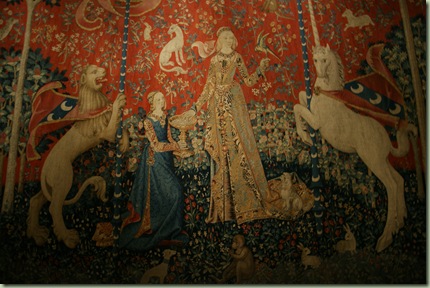
I recalled the delicate 7th century Visigothic votive crowns from my last visit in 1999, but also relished the opportunity to view the museum’s excellent collections of medieval statues and ivories such as the 6th century Ariadne from Constantinople pictured below.  And as a centrepiece exhibit, the museum’s set of tapestries known as The Lady and the Unicorn are justly famed worldwide for their intricate detail and stately beauty. 

DSC01367

DSC01351 DSC01372

DSC01361

DSC01364To complete the day I met former work colleague Bronwyn for a nice dinner nearby.  She now works in Paris, and I was able to catch up on her adventures in France since she left Wellington in 2007.  I was impressed to learn that she now has an apartment on the Blvd St-Germain, which is just about as trendy as you can get in Paris!

Day 3

DSC01387 After breakfast at the hostel I walked to the nearby Pere Lachaise cemetery, a huge suburb of the dead decked out with elaborate mausoleums.  There I admired the tombs of Oscar Wilde, the composer Chopin, The Doors’ Jim Morrison’s humble blocky memorial, and the 19th century tomb for the relocated remains of medieval lovers Heloise and Abelard(Right: Oscar Wilde’s grave)

Then it was time for the big one – an assault on the fabled glories of the Louvre collection.  Saving time by avoiding the queues and purchasing my ticket from a machine in the Carrousel de Louvre underground shopping precinct, I entered at 1pm and spent the next five hours seeing as much as my feet and stamina could cope with.  Highlights are too numerous to mention, and it’s really not possible to do justice to the treasures on display in the vast multi-level galleries that fill the former grand palace by the Seine.  But I did get to indulge my usual fondness for classical sculptures and fine Renaissance paintings, even if it did mean doing battle with the massive throngs of sightseers near the Mona Lisa and the Venus di Milo. 

DSC01405 DSC01421

DSC01429(Above, clockwise: Winged Victory of Samothrace; Mona Lisa; Venus di Milo)  

DSC01443 DSC01462

DSC01464 DSC01469

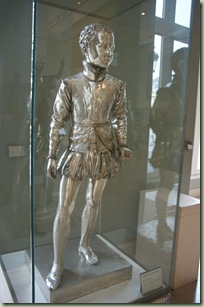
(Above: clockwise from top left: wooden Egyptian mask, 1400-1300BC; silver statue of Henri IV as a boy, 1824; Augustin Pajou’s portrait bust of Natalie de Laborde, 1789; 13th century carving of St Matthew from Chartres)

Cour Puget, Louvre

(Above: sculptures in the Cour Puget)
DSC01491 DSC01494

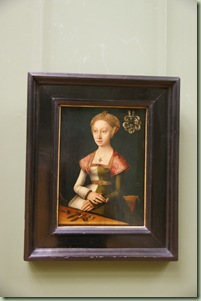
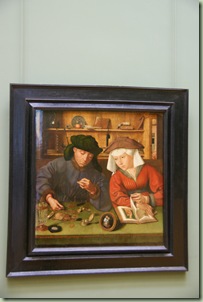
(Above: Quentin Metsys, 1514; Jacob Claesz, c.1520-24)
DSC01510 DSC01512 St Catherine DSC01516

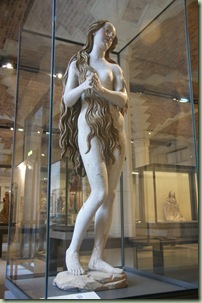
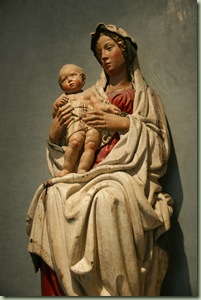
(Above, clockwise from top left: Jacopo della Quercia’s Virgin and Child, 15th century; St Constance, 15th century; Gregor Erhart’s Mary Magdalen, c.1515)

At 6pm the Louvre reduced its ticket price by a third, and this resulted in a deluge of visitors into the galleries, so this was my cue to depart.  But, as always, I’d had a fabulous time.  A day at the Louvre is always a day to remember.

Day 4

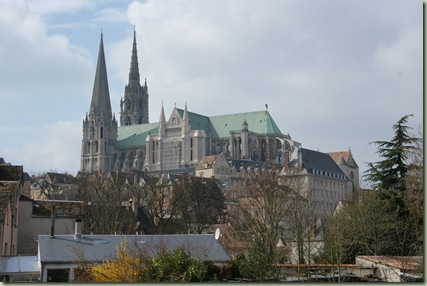
DSC01583 Determined to make the most of my last full day in France, I decided to journey out of Paris to visit Chartres Cathedral, which is one of the marvels of medieval architecture.  The double-decker train from Gare du Montparnasse in the southern suburbs took about an hour, and navigation from the train station was simple because the famous mis-matched spires of the cathedral towers were visible from the platform at Chartres.  (The right-hand spire is from the 1140s, while the left is from the early 16th century).  I walked up the slope to the cathedral yard, admiring the fine statuary adorning the west front and the contrasting medieval spires, built several centuries apart.  Once inside I took an audioguide tour, which highlighted the peerless artistry in the early 13th century stained glass windows and the allegorical tales told by the statues in the north and south porches. 
DSC01571

DSC01528 DSC01540 DSC01542

Chartres North porch

After an hour or two in the cathedral I strolled around Chartres town, admiring the view of the cathedral from the riverside.  Soon it was time to return to Paris though, where I enjoyed my last evening sorting through my photographs and reading.  It had been a superb few days in France, and the following morning I would return to London on the 9am Eurostar.  I had fitted a great deal into my days, but visiting Paris for a short time only reminds you just how much there is to see.  I’ll have to plan another visit soon!