Showing posts with label london. Show all posts

25 June 2024

The totemic London A to Z

If you threw a house party in London in the late twentieth century, before the smart phone rendered it redundant, you could guarantee that the following morning there would be a dog-eared copy of the A to Z [street atlas] behind the sofa, or under the coffee table, probably in a Tesco bag. Everybody had at least one. It was an essential aid in understanding London. It joined the dots and threw up obscure names printed over hitherto unexplored grids of streets: Alperton, Shooters Hill, Honor Oak, Tooting Graveney, Shacklewell, Childs Hill, Ladywell. It invited you to create your own personal map of London, discover your own secret routes, your own special places.

What might be lurking in these locations, waiting to be uncovered on a cold winter Saturday? Corner caffs with Pepsi signs. Second-hand record shops and rickety street markets. Edwardian villas which could be the setting for any number of sitcoms, or could even be the location for Elizabeth Taylor and Mia Farrow's home in Joseph Losey's Secret Ceremony. The photo of Syd Barrett leaning against a car on the back of 1970's "Barrett", has a late Victorian, monochrome backdrop which could have been any corner of London - hence, the photo romanticised just about every corner of London.

You could peruse the A to Z with the knowledge of who lived where - Sandy Denny in Wimbledon, before she moved to Muswell Hill, which was already legendary as the home of the Kinks. Arterial roads as grisly as Archway Road (Rod Stewart's place of birth) or Holloway Road (Joe Meek's studio) or Harrow Road (Mute Records HQ) could be made magic through their pop connections. 

Working out how to get from A to B, let alone to Z, was deeply intricate, slowly accrued knowledge. How do you get to Craven Cottage, or Claremont Road, or the Old Spotted Dog for a three o'clock kick off? When you put your transistor radio in a carrier bag, you remembered to stick your A to Z in there as well. 

- Bob Stanley, liner notes in Bob Stanley presents London A to Z: 1962-1973 (CD compilation), Ace Records, 2023 

25 April 2024

Great injustices are committed upon this land

Thursday music corner: British dub poet and activist Linton Kwesi Johnson (b. Jamaica, 1952) joined his mother in Brixton in 1963 and during his school and university years became increasingly concerned about racism in British society and politics. Graduating with a sociology degree from Goldsmiths College in 1973, Johnson began writing verse targeting the goal of black liberation. He also wrote for music publications in the 1970s including the New Musical Express, Melody Maker and Black Music. 

Johnson released his first album, Dread Beat an' Blood, in 1978, and has released over a dozen albums to date, plus several compilation albums. Reggae Fi' Peach appears on his 1980 album Bass Culture, and honours the memory of New Zealand-born teacher Blair Peach, who died in Southall on 24 April 1979 during an anti-fascist rally against the British National Front. The balance of evidence suggests that the police Special Patrol Group unit was responsible for Peach's death, and also obstructed official investigations to protect the killer. An official report into Peach's death was not made public until 2010, 31 years after the incident.

Linton Kwesi Johnson - Reggae Fi' Peach (live at the BBC, 03.10.81)

See also:
Music: Linton Kwesi Johnson - Peach Dub (1980)
Music: Linton Kwesi Johnson - Di Great Insohreckshan (1983)
Music: The Upsetters - Dollar In The Teeth (1969)

03 April 2024

How the 'heads' of London lived circa 1970

It was still possible for heads to live a low-budget life in London in 1970. Although student numbers were rising steeply as the baby boomers left school, higher education was still only available to 8 per cent of the population (today it nudges 50 per cent). This comparatively privileged group had their education financed by a grant from their local authority, money from their parents if they were lucky, and whatever they had managed to save from a holiday job, which usually involved some form of hard physical labour. With a loaf of bread costing 5p (or one shilling - this was the last year of pounds, shillings and pence), a packet of Embassy cigarettes 20p and a Wimpy hamburger 10p, most of their daily requirements could be covered easily. In many respects the world seemed as economically stable as it had done in the fifties. But 1970 was one year before the decision to take America off the gold standard and the subsequent rise in the price of oil ushered in an era when inflation became endemic. In 1960 the rate of inflation had been 1 per cent. By 1975 it was running at 25 per cent. 

In 1970, heads sharing a flat in central London would expect to pay around £7 each per week. If they were prepared to settle for cheaper areas like Muswell Hill and Finsbury Park Time Out's Book of London predicted they could get a three-room flat for £15. Most of their entertainment was cheap. If they had gone to see Five Easy Pieces, which opened in London at the end of September, they might have paid 30p for their cinema seat. Most of the pleasures and diversions London offered to the tourist were too expensive for heads. They didn't eat out. They never took a taxi. The Time Out guide to alternative London advised that if you had difficulty getting back to the suburbs after a night at Middle Earth you could hitch a lift on one of the lorries leaving Fleet Street in the early hours to deliver the morning papers to the distributors. Credit cards were strictly for the adult world. Banks didn't open at weekends. When they were open they made it clear that they disapproved of anyone taking out any money. Anyone with as much as five pounds on their person was bent on some sort of blow-out.

- David Hepworth, A Fabulous Creation: How the LP Saved Our Lives, London, 2019, p.48-9.

See also:
London: The grooviest place on the planet, 16 July 2018
London: Earl's Court 1968, 16 April 2014
London: Denmark Street, 18 January 2010

16 July 2018

The grooviest place on the planet

A pal sent me this tremendous clip of Soho in July or August '67, which looks fantastic in HD. It looks like the rough footage for a film-magazine piece. The first part is in Carnaby St (above-knee hemlines mandatory), which was probably the trendiest place on the planet at the time, and it goes on to Portobello Rd markets.

07 January 2018

London in the Phoney War

The end of September [1939] found Basil in a somewhat fretful mood. The air-raid scare seemed to be over for the time and those who had voluntarily fled from London were beginning to return, pretending that they had only been to the country to see that everything was alright there. The women and children of the poor, too, were flocking home to their evacuated streets. The newspapers said that the Poles were holding out; that their cavalry was penetrating deep into Germany; that the enemy was already short of motor oil; that Saarbrucken would fall to the French within a day or two; air raid wardens roamed the remote hamlets of the kingdom, persecuting yokels who walked home from the inn with glowing pipes. Londoners who were slow to acquire the habit of the domestic hearth, groped their way in darkness from one place of amusement to another, learning their destination by feeling the buttons on the commissionaires' uniforms; revolving, black glass doors gave access to a fairy land; it was as though, when children, they had been led blindfolded into a room with the lighted Christmas tree. The casualty list of street accidents became formidable and there were terrifying tales of footpads who leaped on the shoulders of old gentlemen on the very steps of their clubs, or beat them to jelly on Hay Hill.

- Evelyn Waugh, Put Out More Flags, London, 1942.

04 August 2017

Keith Moon's brandy breakfasts

[In 1978], four years after the death of Cass Elliot at Harry Nilsson's flat, Keith Moon, after fitting enough partying and convivial nights in his short life for a small town, died of an overdose of Heminevrin tablets in the very same bed.

Keith and his girlfriend, Annette Walter-Lax, had been to a party held by Paul McCartney at the trendy chrome and neon-lit cocktail-bar restaurant called Peppermint Park on St Martin's Lane, Covent Garden. By many accounts Keith was unusually quiet and sober and shared a booth with the McCartneys, David Frost, John Hurt and Kenny Jones - Moon's eventual replacement, ironically. At midnight, everyone went to the Odeon, Leicester Square, for the late-night premiere of the Buddy Holly Story that starred Gary Busey. Before the end of the film Keith and Annette caught a taxi back to Curzon Place. Keith started watching the film The Abominable Dr Phibes but fell asleep after taking several Heminevrin sedatives that had been prescribed to aid alcohol withdrawal. At about 7.30am he ordered Annette to cook him steak for breakfast. She complained but Keith retorted with, 'If you don't like it, you can fuck off'. Unfortunately they were his last words.

Annette, who had been sleeping on the living room couch because of Moon's incessant snoring, discovered him in the afternoon, face down on the bed, and he was found to be dead on arrival at Middlesex Hospital in Westminster [...]

Moon the Loon was only thirty-two when he died, but dying young didn't come to anyone's great surprise - he was one of the greatest partiers ever. He once outlined his typical daily diet to a doctor: 'I always get up about six in the morning. I have my bangers and eggs. And I drink a bottle of Dom Perignon and half a bottle of brandy. Then I take a couple of downers. Then it's about 10 and I'll have a nice nap until five. I get up, have a couple of black beauties [also known as Black Birds or Black Bombers and are a combination of amphetamine, or speed, and dextroamphetamine], some brandy, a little champagne and go out on the town. Then we boogie. We'll wrap it up around four'.

- Rob Baker, Beautiful Idiots & Brilliant Lunatics, Stroud, Gloucs, 2015, p.91-2.

10 March 2016

The grand procession of the scald miserable Masons


A GEOMETRICAL View of the Grand PROCESSION of the Scald Miserable MASONS Design'd as they were Drawn up over against Somerset House, in the STRAND, on the twenty Seventh of April Ano. 1742.

Detail of a multi-page etching, presumably part of the collection of the New Zealand Freemasons, displayed in the Wellesley Hotel, Wellington.  The etching was possibly published in 1771, if it has the same provenance as this identical piece in the collection of the British Museum. An American Masonic author believes the 1742 procession was a satirical jibe by opponents of Freemasonry, rather than a legitimate Masonic event. The Somerset House depicted is the previous occupant of the prestigious site; this earlier, Tudor palace was demolished in 1775 to make way for the current palace.

26 February 2016

El chico con la espina en el costado

Mexican Morrissey tribute band 'Mexrissey' perform The Boy With The Thorn In His Side at a chilly-looking London bus stop, and discuss why their home country has such a strong bond with the northern indie legend.


See also:
Music: Balkanistas, 13 December 2015
Music: Brigitte Bardot, 13 November 2015
Music: Dr Feelgood, 4 July 2015

24 September 2015

Mail coaches - London departure points

'The mail coaches in their early years departed from the General Post Office in Lombard Street every week-night between 8 and 8.20pm. It was a great sight; and even more spectacular after the new GPO was opened in 1829 in St Martin's le Grand.

During the day the vehicles were greased, cleaned, and polished in the coachyard at Millbank, Westminster. Then, about five o'clock, two horses drew them slowly along the cobbled streets to various inns near the GPO. The Swan with Two Necks, in Lad Lane, a thoroughfare near Gresham Street which, like the inn, has since disappeared, was one of the most important. From its yard departed the mail coaches for Exeter, Bath and Devonport; Salisbury and Exeter; Exeter, Devonport, and Falmouth; Nottingham and Halifax; Birmingham, Shrewsbury, and Holyhead (for Ireland); Peterborough, Lincoln, and Hull; Lichfield, Warrington, and Liverpool; Ipswich and Norwich; Bristol and Pembroke; Manchester, Carlisle, and Port Patrick; Southhampton and Poole; Cirencester and Stroud; Cambridge, King's Lynn, and Wells-next-the-Sea; and Dover.

From the Golden Cross at the Charing Cross end of the Strand mail coaches left for Gloucester and Carmarthen; Dover; Nottingham and Halifax; Hastings; Cirencester and Stroud. From the Bell and Crown, Holborn, the coaches took on passengers for Salisbury and Exeter; Boston and Louth; Cambridge, King's Lynn, and Wells-next-the-Sea. At the Spread Eagle, Gracechurch Street, the routes covered were Exeter, Devonport, and Falmouth; and Peterborough, Lincoln, and Hull. At Blossom's Inn, Lawrence Lane, stood the Brighton coach. At the Bull and Mouth, St Martin's Lane, Wetherby, Carlisle, and Glasgow; Nottingham, Sheffield, and Leeds; Worcester and Ludlow; Exeter, Falmouth, and Penzance; Edinburgh and Thurso. From the Saracen's Head, Snow Hill, the coach for Boston and Louth. From the White Horse, Fetter Lane, Portsmouth; and Ipswich and Yarmouth. From the Belle Sauvage, Ludgate Hill, Newmarket and Norwich; and from the Bolt-in-Tun, Fleet Street, Portsmouth and Hastings.

In the yards of these inns the four horses to take the coach on its first stage were harnessed, while the luggage was stowed on board and passengers settled down for their long journey through the night. The scenes must have been as bustling and exciting as anything at a modern railway terminus, and the onlooker at the Swan with Two Necks must have marvelled at the fact that within this single yard travellers could step aboard a vehicle which would take them to the four corners of the country - to Ipswich or Falmouth, Holyhead or Leeds. Eight coaches all due to leave simultaneously to take up their position in a single file outside the GPO was a sight that Londoners loved to see, and was a matter of wide-eyed wonder to the rural traveller on his first visit to the Metropolis'.

- F. George Kay, Royal Mail. The Story of the Posts in England from the Time of Edward IVth to the Present Day, London, 1951, p51-2.

12 August 2015

This great ebbing surging traffic of London

From Jo Baker's novel Longbourn, which tells the well-worn story of Jane Austen's Pride & Prejudice from the house servants' perspective, comes this description of a coach journey into London circa 1813. It is told from the perspective of the Bennets' housemaid Sarah, who is strapped into the rumble-seat atop the chaise while Miss Elizabeth Bennet and company reside more comfortably inside. Sarah's perspective of London - her very first, much longed-for visit - is therefore seen facing backwards.

---

The ground blurred beneath the humming wheels, and the sky was pale blue and clear above her, and from the other side of the calash she could hear the voices of the more comfortably situated passengers, and Sir William, who cried out, when they crossed a simple sluggish river choked with reeds, 'The mighty Thames!'

They skimmed along past high hedges, through villages strung along the road like beads upon a thread. They passed between deep fields of watercress, trickling with rills of chalk-clean water, smelling sharp and peppery and green. They passed through market gardens, the raised beds thick with growth, mulchy and warm. The fields grew smaller, subdivided, the market gardens more closely packed, with sheds and lean-tos built of clapboard and rough timber. They slower at a flock of geese that flapped and honked onto the broad grassy verge, chivvied there by a girl in a broad-brimmed hat who hissed back at them and swiped at them with a stick, and, after the chaise had passed, stared frankly back at Sarah, her face red and scrofulous. They clattered through a ford and water heaved up on either side in fountains. There was a smell of shit from the brown-skimmed fields, and the cattle stood thin and unmoving as though cut from painted tin. And then the road was sloping down, and there was more traffic, trailing long-wagons, painfully slow, bouncing gigs and carts, and post-chaises, and then a mail-coach thundering past; and then they were rattling over cobbles and deep into town, Sarah's head tilting back and her mouth falling open as she looked up at the buildings rearing above her like cliffs that stared at each other across a stream; and the stream was the traffic, and she herself was part of the traffic, this great ebbing surging traffic of London, the cabs and barrows and drays and carts and the people, just the endless variousness of the people: fishwives in raucous stinking gangs; barrow-boys with their jaunty caps and their bold eyes; a beggar in a filthy rag of a red coat who scooted along on stumps then fists, stumps then fists; a milkmaid with pails swinging from a yoke, whose milk looked bluish grey, and slopped queasily, and left bits on the insides of the buckets, and did not look like the milk at home at all. The streets were slick with dung, and there was a taste of soot in the air, and the smell of cesspits, and bad vegetables, and fish. And the noise - iron-clad wheels, iron-shod hooves, the cries of the costermongers and dockers, muffin-sellers and cabbies, and the crowds, and the jostling and pressing up close, and the horses of the coach behind nodding in tandem at her. Then a dirty-looking youth slipped between the carriages; he dodged up to her, and she thought he was going to say something, but he just made a grab for her skirts, ruffling them back: he slid his hand over the top of her stocking, and then in between her thighs. She pulled away, kicking out at him, fumbling her skirts down; he retreated, grinning, showing a black gap where his front teeth should have been. He was gone before he'd ever really been there, and left her shaking.

And to think it had once seemed a good idea to come here alone.

- Jo Baker, Longbourn, London, 2013, p.205-7.

See also:
History: Coach travel from London, 1658 & 1739, 4 October 2013
History: Stagecoach travel in the Old West, 19 March 2015
History: Public transport comes to Onehunga, 10 February 2015

03 June 2015

That's a high wine-to-pounds ratio

South African wine at Lidl Finsbury Park, the dipsomaniac's friend.

30 October 2014

The Dissection of Jeremy Bentham, or the Auto-Icon

On the unusual events that occurred immediately following the death of English philosopher Jeremy Bentham (1748-1832), one of the key founders of utilitarian thought:

He had specified in his will that his body was to be offered up for public dissection, a useful thing in itself. At that time, because of the doctrine of the resurrection of the flesh (when Christ will supposedly return at the Last Judgement to open the graves of the dead), there was still a Christian taboo against not burying bodies. This meant there was a general shortage of specimens for pathologists to work on. 
Before the dissection began, at London's Webb Street School of Anatomy, twenty-eight of Bentham's friends gathered to say farewell. His corpse lay before them in a simple nightshirt. In a scene straight out of Mary Shelley's Frankenstein (then just into its second edition), the funeral oration was dramatically accompanied "with thunder pealing overhead and lightning flashing through the gloom". Once the eulogy had finished, Dr Southwood Smith made sure, as Bentham's will had specified, "to ascertain by appropriate experiment that no life remains". He then carefully stripped the flesh from the bones and placed the internal organs and "the soft parts" in labelled glass containers "like wine decanters". His cleaned bones were then pinned together with copper wire and the skeleton dressed in a suit of Bentham's clothes, padded out with hay, straw and cotton wool. A sachet of lavender and naphthalene was placed in the stomach cavity to discourage moths. Again adhering to the instructions in his will, the body was seated in "a Chair usually occupied by me when living in the attitude in which I am sitting when engaged in thought". The whole ensemble was to be enhanced by the presence of Dapple, his favourite walking stick, and topped off with his actual head (well preserved and with a suitable hat on it). 
- John Lloyd & John Mitchinson, The QI Book of the Dead, London, 2009, p390-1.

The head preservation didn't go according to plan, so a waxwork model was put in its place, but the real Bentham's mummified head was placed into a display cabinet with the rest of the 'exhibit' and lay at Bentham's feet, until it was placed into safe storage much later, on account of it being subject to many university pranks. These resulted because Bentham's body has been on public display since his death. Since 1850 the body, which Bentham described as his 'Auto-Icon', has resided in University College London, and his remains can still be seen today.

The Times of 7 June 1832, the day after Bentham's death in London aged 84, carried an obituary 'from a most respectable [unnamed] gentleman well acquainted with the deceased':

In conformity with the desire of his father, he practised for a short time in equity, and was immediately remarked for the ability he displayed; but the death of his father left him with a moderate fortune and the free choice of his course of life, when he at once abandoned all prospects of professional emoluments and honours, and devoted the whole of his subsequent life to those labours which he believed would produce the greatest happiness to his fellow-creatures. His extreme benevolence and cheerfulness of disposition are highly spoken of by all who had the honour to be admitted to his society, which was much sought after, and also by his domestics and by his neighbours who were acquainted with his habits. The news of the Reform Bill having been carried greatly cheered his last hours.     

18 October 2014

A little light blasphemy

(London, 1532. A gathering of merchants discusses civil disorder in the city:)

Humphrey Monmouth says, 'Shall we have our meeting first, and broker marriages later? We are concerned, Master Cromwell, as you must be, as the king must be ... we are all, I think', he looks around, 'we are all, now Bonvisi has left us, friendly to the cause for which our late brother Petyt was, in effect, a martyr, but it is for us to keep the peace, to disassociate ourselves from outbreaks of blasphemy...'

In on city parish last Sunday, at the sacred moment of the elevation of the host, and just as the priest pronounced, 'hoc est enim corpus meum', there was an outbreak of chanting, 'hoc est corpus, hocus pocus'. And in an adjacent parish, at the commemoration of the saints, where the priest requires us to remember our fellowship with the holy martyrs, 'cum Joanne, Stephano, Mathia, Barnaba, Ignatio, Alexandro, Marcellino, Petro...' some person had shouted out, 'and don't forget me and my cousin Kate, and Dick with his cockle-barrel on Leadenhall, and his sister Susan and her little dog Posset'.

He puts his hand over his mouth. 'If Posset needs a lawyer, you know where I am'.

'Master Cromwell,' says a crabbed elder from the Skinners' Company, 'you convened this gathering. Set us an example in gravity'.

- Hilary Mantel, Wolf Hall, London, 2009, p.384-5.

11 October 2014

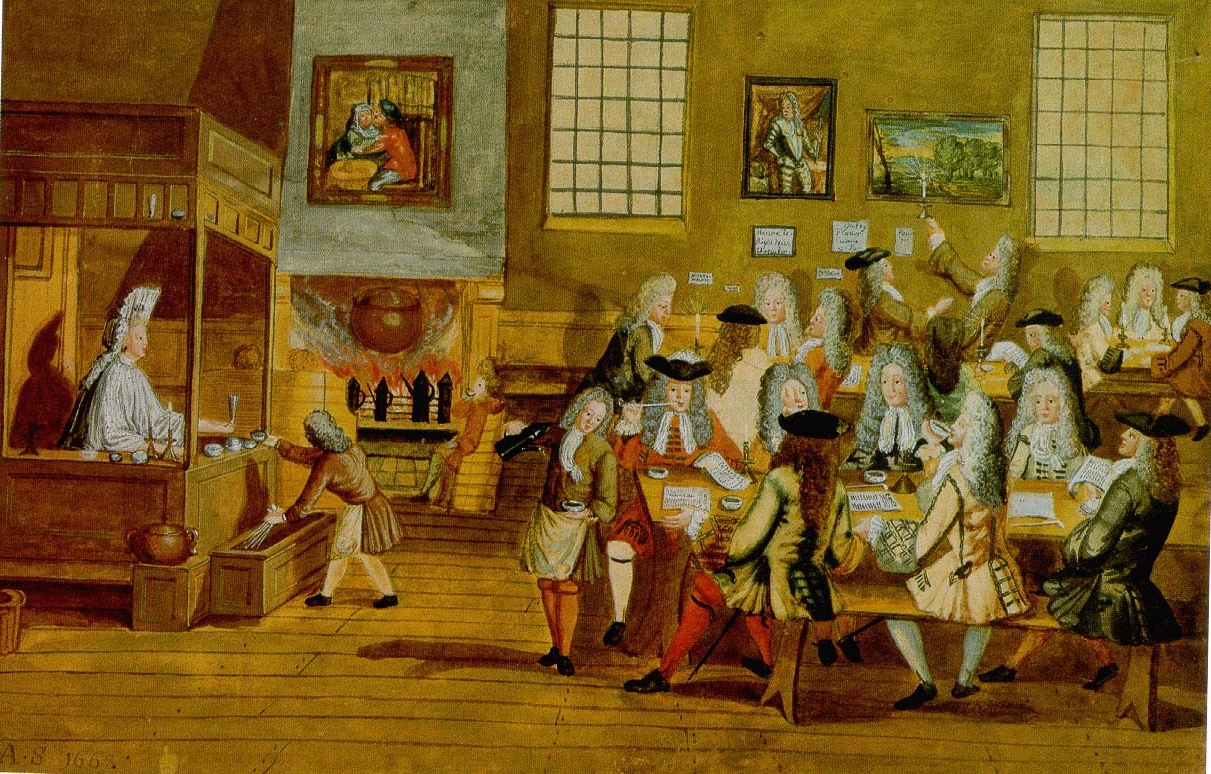
Doing his suit at the coffee-house

London coffee-house interior, 17th c. (via Wikimedia)
'When coffee became popular in Oxford [in the 17th century] and coffeehouses began to multiply, the university authorities objected, fearing that this was promoting idleness and diverting students from their studies. Anthony Wood, an Oxford antiquarian, was among those who denounced the enthusiasm for the new establishments. "Why doth solid and serious learning decline, and few or none follow it now in the university?" he asked. "Answer: Because of coffee-houses, where they spend all their time". Similar concerns were voiced in Cambridge, where one observer noted that it "is become a custom after chapel to repair to one or other of the coffee houses (for there are divers), where hours are spent in talking, and less profitable reading of newspapers, of which swarms are continually supplied from London. And the scholars are so greedy after news (which is none of their business) that they neglect all for it, and it is become very rare for any of them to go directly to his chamber after prayers without first doing his suit at the coffee-house, which is a vast loss of time grown out of pure novelty. For who can apply close to a subject with his head full of the din of a coffee-house?"'

- Tom Standage, Writing on the Wall: Social media - the first 2000 years, London, 2013, p.111-2.

---

In 'Covent Garden, the Bedford Coffeehouse had a ‘theatrical thermometer‘ with temperatures ranging from ‘excellent‘ to ‘execrable’. Playwrights dreaded walking into the Bedford after the opening night of their latest play to receive judgement' (Telegraph, 20 March 2012). Extracts from the Memoirs of the Bedford Coffee-house (1763), citing the journal of the establishment, in which esteemed customers left messages for one another:

  • 'Lord Terrible's compliments to Jack Firebrace, intends to be very jolly to night, and get damned drunk at Weatherby's, with Bet. Saunders and Nancy Davison. - Hopes to have his company'.
  • 'Jack Firebrace is engaged till twelve; but will certainly spend the evening according to Lord Terrible's desire, and bring with him Tom Tearall, and Ned. Crackpole, who have heads like rocks, and have been hell-fired drunk these ten days'.
  • 'Dr Gonnorrhoea's compliments to Sir Timothy Whiffle, is very sorry he was not in the way when he called upon him - He may take the pills and use the injection as before, if he finds no alteration. Will be at home to-morrow until twelve'.
  • 'This is to acquaint Mr Didlius, that he is a puppy and a rascal'.
---

An article in The Times of Monday, 11 June 1792, reporting an avian invader at Lloyd's Coffee-House, or conceivably an elaborate pun on a trader named Drake:

Lloyd's coffee-house in an uproar
On Saturday, about one o'clock, the neighbourhood of the Royal Exchange was highly entertained by a Duck-hunt: it seems that a Duck of uncommon size had waddled from the Stock Exchange the last settling-day, though evidently in full plumage
Information being received at the Stock Exchange that the duck had very unexpectedly made it's appearance at Lloyd's, a large detachment of the alley-brokers sallied up stairs to take a view of it. They poured in such a torrent into the coffee-room, and made such hideous cries, that it was thought all the bulls and bears in Christendom had been let loose. No bull was ever more cruelly baited. The wretched duck at last thought fit to fly off, but was pursued with unabated vengeance down Bartholomew-lane and Lothbury; the alley gentry calling out wing the duck - stop the bull, etc. The poor animal harassed and fatigued, at length eluded its pursuers, and took shelter in a house in Lincoln's-inn-fields, where it found safe habitation.
See also:
History: 'Drunk, by Jove!', 22 February 2013
History: An old Wandle snuff mill, 13 January 2011
HistoryThe last grand night ascent at Vauxhall, 30 September 2010

16 June 2014

Otherwise known as 'sodcasting'

Spotted yesterday at Honor Oak Park station in southeast London, this poster encourages passengers to refrain from annoying their fellow commuters with tinny headphone noise, a.k.a. sodcasting. Which is officially a pain in the bum. I suppose that's one advantage of the curious popularity of Dr Dre's overpriced Beats headphones - at least they keep the noise in relatively well on the bus or train.


06 June 2014

What manner o' thing is your crocodile?

This afternoon's entertainment involved taking in the RSC production of Antony & Cleopatra at the Globe, featuring the excellent Eve Best as the legendary Egyptian queen. I saw Best in the film of the Globe's Much Ado About Nothing a year or two ago and was taken with her performance then; it's great to know she's consistently that impressive. The whole performance was splendid, and I'm glad I've finally seen the play performed by the very best actors around.

It was my first visit to the Globe as a groundling in the yard, and while my feet did start to ache I had positioned myself at the fence so could at least lean against it. Many of the groundlings seemed to be young German visitors, and I wonder how much they understood of the story, given those of us with a lifetime of English sometimes struggle with the Bard.

Here's one of my favourite comic passages from the play, as Antony 'explains' the nature of a Nile crocodile to Lepidus:

LEPIDUS What manner o' thing is your crocodile?

MARK ANTONY It is shaped, sir, like itself; and it is as broad as it hath breadth: it is just so high as it is, and moves with its own organs: it lives by that which nourisheth it; and the elements once out of it, it transmigrates.

LEPIDUS What colour is it of?

MARK ANTONY Of its own colour too.

LEPIDUS 'Tis a strange serpent.

MARK ANTONY 'Tis so. And the tears of it are wet.

05 June 2014

Helpful advice for train passengers

'To the adult in charge of the school party that just boarded this train, that is NOT the way to board a train. The children were leaping on and off the train and holding open the closing doors, which led to the late departure of this service. We are now running one minute late. I'm sorry, I'm not usually this stressed'.

- Announcement on the 1758 from London Victoria, 4 June

23 April 2014

Remembering Blair Peach

Blair Peach (Guardian, via public domain)
Today is the 35th anniversary of the unlawful killing of 33-year-old New Zealand teacher Blair Peach in Southall, south London, by officers of the Metropolitan Police. Peach was attending an anti-fascist demonstration against the far-right National Front on 23 April 1979, and he died of head wounds the following day at the New Ealing Hospital. No-one was ever charged with Peach's death. A 2010 inquiry report, much delayed by official denials and obfuscation, agreed that evidence - including 14 eye witness accounts - 'almost certainly' points to a member of the Met's Special Patrol Group having dealt Peach the fatal head wound. A 2010 Guardian report on the Met's inquiry notes:

Suspicions centred on the SPG carrier U.11, the first vehicle to arrive on Beechcroft Avenue [sic.], the street where Peach was found staggering around and concussed. [Commander John] Cass said there was an "indication" that one officer in particular, who first emerged from the carrier but whose name has been redacted from the report, was responsible. 
The criminal investigation into Peach's death was hampered by SPG officers, who Cass concluded had lied to him to cover up the actions of their colleagues. He "strongly recommended" that three officers should be charged with conspiracy to pervert the course of justice, giving detailed evidence to show how they were engaged in a "deliberate attempt to conceal the presence of the carrier at the scene at that time". None were ever charged.

The original 1979 police documents adopt some unusual methods, like redacting the name of the National Front's candidate, whose planned rally at Southall Town Hall spurred the Anti-Nazi League counter-rally that Peach attended. This would have been a simple matter of public record.

Times editorial on 14 January 1980 noted that 245 people had died in British police custody in the past decade, although it is unclear whether that is referring to solely the Metropolitan Police or a larger grouping. According to Inquest, in the 10 years from 2004 to 2013 there were 93 recorded deaths in Met custody, and 519 deaths in police custody across England and Wales.

The Met's Commissioner, Sir Paul Stephenson, said in 2010:

As a police officer with over thirty four years service reading and being briefed on the investigation reports leaves me feeling deeply uncomfortable. Thirty one years later we have still been unable to provide the family and friends of Blair Peach with definitive answers regarding the terrible circumstances of his death. That is a matter of deep regret. 
See also:
News: 'Partner of man killed by Met officers calls for investigation to be made public', Guardian, 13 June 2009

16 April 2014

Earl's Court, 1968

Juan insisted, after our first meeting, that whenever I came to London I stay at his pied-a-terre in Earl's Court. He was almost never there because he spent most of his time in Newmarket, transferring real equines to canvas. I'd be doing him a favour if I aired out his apartment from time to time [...]

I liked Earl's Court very much and fell in love with its fauna. The district breathed youth, music, lives lived without caution or calculation, great doses of ingenuousness, the desire to live for the day, removed from conventional morality and values, a search for pleasure that rejected the old bourgeois myths of happiness - money, power, family, position, social success - and found it in simple, passive forms of existence: music, artificial paradises, promiscuity, and an absolute lack of interest in other problems that were shaking society. With their tranquil, peaceful hedonism, the hippies harmed no one, and they didn't proselytize, didn't want to convince or recruit people they had broken with in order to live their alternative lives: they wanted to be left in peace, absorbed in their frugal egotism and their psychedelic dream [...]

Many hippies, perhaps the majority, came from the middle or upper classes, and their rebellion was familial, directed against the well-regulated lives of their parents and what they considered the hypocrisy of puritanical customs and social facades behind which they hid their egotism, insular spirit, and lack of imagination. Their pacifism, naturism, vegetarianism, their eager search for a spiritual life that would give transcendence to their rejection of a materialist world corroded by class, social, and sexual prejudices, a world they wanted nothing to do with - this was sympathetic. But all of it was anarchic, thoughtless, without a centre or direction, even without ideas, because the hippies - at least the ones I knew and observed up close - though they claimed to identify with the poetry of the beatniks (Allen Ginsberg gave a reading of his poems in Trafalgar Square in which he sang and performed Indian dances, and thousands of young people attended), in fact read very little or nothing at all. Their philosophy wasn't based on thought and reason but on sentiment, on feeling.

- Mario Vargas Llosa, The Bad Girl, 2006.

See also:
London: Mr CD in Soho, 17 October 2013
London: George Fordyce & Dolly's Chop House, 22 February 2013
LondonSpringtime in Wimbledon, 24 March 2011

17 October 2013

Mister CD

Recently when delving into my many boxes full of the random detritus from years of flatting and travelling, I came across an artefact of a sadly departed fixture of the London music scene - or at least, a fixture of my own small London music scene. It was a simple used plastic carrier bag from the now defunct Soho music shop Mister CD, an establishment that I used to frequent with an almost devotional regularity during my London years. It was particularly important during my first years in London during the late 1990s, chiefly because my income was so comically low at that point. I usually couldn't afford the full-price music for sale on Oxford Street in the Virgin or HMV megastores, but I still enjoyed browsing their comprehensive collections for an occasional bargain. But if I absolutely had to have an album, it was Mister CD that usually provided.

Located in a tiny old shop at 80 Berwick Street, it was always a mission to infiltrate the premises, because the aisles were tiny and the browsing customers went plentiful. CDs were shelved from floor to ceiling, so much of the challenge was finding the right spot and surveying the entire shelf without being edged out of position by your fellow, equally determined, music shoppers. This was in the day when £13 for a new CD was a lot of money to me, so it was great to have the slightly down-at-heel Mister CD option a short walk away from the big stores, and where you could usually pick up a new release - like Pulp's This Is Hardcore or Catatonia's International Velvet for example - for a tenner or less. 

But my main loitering space at Mister CD wasn't in the ground level shop. I usually made a beeline for the rickety stairs down to the basement dungeon where the remainder CDs were displayed. Down there, if it was a Saturday, the stereo was usually blasting a football match for the benefit of the sales clerk, and the CDs were scuffed, displayed in craft-knife-hacked cardboard boxes from the supermarket, and of widely variable quality. They were also, as you might imagine, fantastically cheap. It was often possible to pick up some pleasingly obscure reissue or remainder stock for a pound or two, if you could put up with the football. I have fond memories of securing a review copy of the first ENZSO album for a mere quid there.
  
I was never much of a Selectadisc devotee (the shop at 34 Berwick Street that specialised in much hipper vinyl collections - now run by Sister Ray). For me, Mister CD was all I needed. Even when I returned to live in London a second time in the 2000s and could afford to spent a little more, I still made a regular pilgrimage to Berwick Street for the bargain sifting. But, sadly, by that time the shop was on its last legs. Mister CD closed in 2007, earning a sympathetic news report from a BBC business reporter, who noted:
Mister CD's imminent closure marks another chapter in the decline of what used to be renowned as the street with the greatest concentration of record shops in London. Collectors from all over the world flocked to Berwick Street to look for vinyl rarities in its second-hand shops, while others were tempted by the chance to snap up new CDs at low prices. The street was so well known as a haven for music fans that it even featured on the cover of one of the UK's all-time best-selling albums - (What's The Story) Morning Glory? by Oasis.

Mister CD couldn't compete with online retail, the threat of downloads and the cut-price competition from the big stores and Scottish chain Fopp, which opened an impressive discount store nearby on Shaftesbury Avenue. But for a decade and a half, Mister CD was a stalwart of the London music scene - a no-nonsense outlet for fans and bargain-hunters alike.


See also:
Gig: The Magic Numbers, Shepherd's Bush Empire, 11 October 2010
Gig: She & Him, Shepherd's Bush Empire, 10 May 2010
Gig: Liam Finn & friends, Scala, 2 December 2008
Gig: Jarvis Cocker, Shepherd's Bush Empire, 26 November 2008 
Gig: Grant-Lee Phillips, Scala, 27 April 2008
Gig: Aimee Mann, Indigo2, 27 July 2007
History: Denmark Street, 18 January 2010