Showing posts with label photography. Show all posts

24 August 2026

Grayson Perry, on Martin Parr

When I first came upon the photography of Martin Parr in a colour supplement at some point in the 1980s, a very loud bell rang. Here was someone who was pointing out with laser precision the aspects of society I didn't even know I was driven by. He framed anthropological observations that I didn't yet know I was fascinated by. Class, identity, individualism and belonging, what it is to be British: in these subjects, Martin's photos are my guiding text. Often the most affecting encounters with culture are those that make concrete the wisps of feeling we have been sensing for years. For me, the photographs of Martin Parr did just that, and I'm sure they have done the same thing for millions of other people all over the planet.

Since that first encounter, his work has been a guiding beacon for me, pointing out patterns and dissonances in society, but more importantly showing me how to look. Over the course of his long and vastly prolific career - to date he has produced more than 100 books and many more exhibitions - Martin has developed an anthropological 'sat nav' that will reliably take him to where his hyper-developed image-making skills can play and disrupt. His genius is not just in spotting the shot, but in booking the flight and getting the access [...]

One of the first things I asked him is something I'm sure other people must wonder: 'How do you get away with taking some of these photographs?' If I saw Martin striding purposefully towards me with a camera, I would be tempted to run. The few times he has taken my photo, I have ended up looking like someone in a Martin Parr photograph. I stare blankly out, my pretentions pinned like a butterfly to a card. I have occasionally seen him at work in the field, alert but camouflaged by banality. He has developed a carefully crafted image: the genial dowdy everyman that no one will notice, in faded clothes and sandals, who pokes the camera in someone's face with utter confidence and then turns away and disappears into the background the split second after pressing the shutter.

- Grayson Perry, in Martin Parr: Only Human, London, 2019, p.10-11. 

05 August 2026

The lucrative profession of photography in 19th century New Zealand

Alfred Burton's [1885 photo montage] The Maori at Home will always remain a remarkable and unique record. A few years earlier the journey would have been impossible or at least suicidal. A few years later the Maori had become sophisticated in front of the camera. This work deservedly gained him the Fellowship of the Royal Geographical Society. And it undoubtedly brought the firm kudos that was reflected in all the branches of their photographic work. Burton Brothers became a national New Zealand concern and known widely abroad.

Just how much Alfred gained financially from these important additions to the catalogue of topographical and ethnographical photographs it is not possible to say, because no account books of the period have survived, and, as has been emphasised before, many photographers in Dunedin who specialised in portraiture during the formative years appear also to have done well.

The record of freeholders in New Zealand which was published in 1882 gives some idea of relative prosperity in the profession. Robert Clifford, apart from his dwelling in Fleet Street, had freehold property in Mornington, the North East Valley, and West Harbour, to a total value of £1,710; Frederick Henry Irwin, of the London Portrait Rooms, held freehold property to the value of £3,500; Alexander Peyman, no longer in partnership with Irwin and living in England, owned 1,273 acres at Wanganui valued at £12,730, and properties to the value of £7,870 in Oamaru and £2,500 in Dunedin, and Caroline Peyman at Wanganui had freehold property to the value of £1,737; William Meluish, living in England, had in 1882 freehold property in Dunedin to the value of £8,820, and Alfred Burton held freehold an acre and dwelling at Sunnyside, Roslyn valued at £780 and property in Dunedin giving a total of £1,180. These figures, at that date and viewed relatively, may not signify great wealth, but they do suggest that the top photographers were men of social standing and some substance.

- Hardwicke Knight, Burton Brothers: Photographers, Dunedin, 1980, p.34-5. 

24 June 2026

Brassaï's Parisian night photography

Here is Brassaï himself, towards the end of his life [in a 1976 interview with Claude Bonnefoy], describing one of his night-time expeditions in the early 1930s: 'I used to spend whole nights beside the canal, waiting for the right moment to take the shot, or in other words for a little fog to soften the lights. Often the hirondelles, the policemen on bikes, seeing a man squatting down would stop and ask me: "What are you up to?" And I'd say: "I've come to take a photo." At two in the morning, that seemed like an odd thing to do. So, I'd have a couple of prints on me so I could show them what it was possible to achieve at night. Then the ones that liked taking pictures would ask me for advice. I explained to them that I had several exposure times - the "Gauloise exposure", in other words the time it took to smoke a Gauloise, and the "Boyard exposure", which was about twice as long. This airy description, long after the event in question, contrasts with remarks made by Brassaï during the 1930s when he referred to 'a period of endless experiments with developers and exposure times', which were probably closer to the truth. The table of exposure times, reproduced at the back of Camera in Paris, shows that far from being a mechanical and repetitive practice the calculations involved a number of parameters, including natural lighting conditions and supplementary light sources. The exposure time could be anything from a fraction of a second to ten minutes or longer: 1/50 of a second for a photograph taken using flash ('14 July, Place de la Bastille'; 'Parisian cats'), one minute without supplementary light ('A carriage in front of "Le Dôme""), ten minutes for a Seine embankment shrouded in fog, or a panoramic view taken from one of the towers of Notre-Dame.

- Sylvie Aubenas & Quentin Bajac, Brassaï: Paris Nocturne, London, 2013, p.196-98.

24 March 2026

The origins of Dr Strangelove's accent

Weegee's most striking photographs were made on the War Room set, where much of the drama of Dr Strangelove takes place. Visionary production designer Ken Adam's expressionist, windowless interior was all dark gloss surfaces and angled walls, with a huge circular table illuminated from above, like a poker room. Since there were no public images of the U.S. government's real Pentagon War Room, Ken Adam was free to imagine it (just as he imagined the unseen interior of Fort Knox for the James Bond movie Goldfinger, also released in 1964). Preeminently a photographer of the night, Weegee was perfectly at home in the darkened space. He could use his flash or the production's bright lights to pick out his subjects, just as he had done in the treacly midnights of 1930s and '40s New York. His portrait of Peter Bull, playing Russian ambassador Alexi de Sadesky, looks as if it could have been taken in the crowd at a Manhattan theater premiere.

The British actor Peter Sellers was tasked with playing three key roles in the film: U.S. President Merkin Muffley, Captain Lionel Mandrake of the British Royal Air Force, and the eerie Dr. Strangelove - a former Nazi who is now the President's chief scientific advisor. Sellers was also a keen amateur filmmaker, shooting many home movies as well as photographs. He and Weegee struck up an endearing friendship on set. Sellers had an extraordinary ability to absorb and mimic accents, and became fascinated with Weegee's way of talking, which was a gruff but sweet cocktail of eastern European consonants and streetwise New York vowels. Sellers needed very distinct accents for each of his parts. His impression of Weegee became the basis of his voice for Dr. Strangelove. On a TV talkshow shortly after filming, Sellers recalled:

"I was stuck, you see, because I didn't want to do sort of a normal English broken German accent thing, so on the set was a little photographer from New York, a very cute little fellow called Weegee. You must have heard of him. And he had a little voice.... And I got an idea... I put a German accent on top of that, and I suddenly got... him into Dr. Strangelove. So really, it's Weegee. I don't know if he knows it."

- David Campany, 'Weegee & Kubrick', in Clement Cheroux (ed.), Weegee: Society of the Spectacle, London, 2025, p.193.

See also:
Photography: Dennis Hopper: photographer, 15 September 2025
Photography: Sherman meets Blanchett, 8 May 2022
Photography: Who Shot Rock 'n Roll, 1 January 2013

15 September 2025

Dennis Hopper: photographer

The aftermath of Hopper's first film as director saw the global superstar and auteur on a self-exiled binge in Taos, New Mexico. Wrangling footage of his second, The Last Movie, into something approaching coherence while remaining true to shifting principles of incoherence proved predictably tough going - not least for anyone expected to sit through the result. Hopper's banishment was by then complete, but it was not unprecedented. After repeated run-ins with director Henry Hathaway on the set of From Hell to Texas he was effectively blackballed by Hollywood at the tender age of twenty-one.

He went to New York, where he studied with Lee Strasberg and fell in love - with modern art and [his first wife] Brooke [Hayward], James Dean had urged him to start taking photographs when they were filming Rebel Without a Cause in 1955 but Hopper did not get a serious camera a birthday present from Brooke until 1961. Back in LA the couple discovered a simmering art scene that was about to come to the boil. Hopper was in its midst as collector (he bought one of the first Warhol soup-can paintings), participant, friend and witness.

He was shy he said later, and liked the way the camera gave him something to fiddle with. As in a low-budget indie production, the nascent scene had a cast of dozens, some natives of this coastal paradise (like his lifelong friend, curator and impresario Walter Hopps), others, like Hopper himself (Kansas) and Ed Ruscha (born in Nebraska, raised in Oklahoma) from the Midwest. In opposition to the psychological depths plumbed by Abstract Expressionism (Hopper's first painterly passion in New York), LA art relished and reflected the mass visual culture of southern California. 'Pop' may have been a conceptual import, but its raw materials could be locally sourced. The streets were full of stuff that would end up in the paintings (and the photographs): cars, gas stations, billboards for the movie stars whom Hopper counted among his friends. They brought a glamour to the art which, in turn, celebrated the profundity of the superficial. The marriage of showbiz and art has been enduring, as a merger, it has proved stunningly lucrative.

- Geoff Dyer, See / Saw: Looking at Photographs, Edinburgh, 2021, p.80-81.

See also:
Photography: Joel Meyerowitz: the heart of the photographic moment, 9 July 2024
Photography: Cindy Sherman: chameleon, comedian, 15 January 2017
Photography: Ans Westra: Wellington 1976, 30 June 2013

20 May 2025

Man Ray the photographic liberator

On the occasion of Man Ray's retrospective exhibition at the Los Angeles County Museum of Art in 1966, the German Dadaist Hans Richter contributed a catalogue essay in which he succinctly captured the creative vision of his friend of forty years: There is no eggshell, no thermometer or metronome, no brick, bread or broom that Man Ray cannot and does not change into something else. It is as if he discovers the soul of each conventional object by liberating it from its practical function. Further elaborating on the artist's practice, he noted that Man Ray 'just cannot help to discover and reveal things because his whole person is involved in a process of continuous probing, of a natural distrust in things being "just so"".

Over the course of a half-century creative career spanning two continents and two world wars, Man Ray's process of continuous probing was nowhere acutely manifested than in his idiosyncratic photographic practice. Playfully experimenting with dramatic use of light, shadow, perspective and framing as well as inventive techniques such as positive / negative reversal, double exposure and solarization, Man Ray pioneered conceptual approach to the medium that liberated it from steadfast orthodoxies by which it had been bound since its inception. His rejection of the conventional belief in photography as a transparent reflection of reality and his radical approach to image making generated new appreciation for the medium's potential as an art form and a vehicle for accessing what Walter Benjamin termed the 'optical unconscious'. In the words of Man Ray, photography 'is a marvelous explorer of those aspects that our retina never records'.

- Wendy Grossman, 'Liberating photography', in Nathalie Herschdorfer, Man Ray: Liberating Photography, London, 2024, p.10 

18 May 2025

The world's first photographic portrait studio

How rapidly a combination of inventiveness and business sense can lead to success can be seen in the collaboration of [Alexander] Wolcott and [John] Johnson, partners in a New York manufactory which produced and distributed optical instruments and other equipment involving precision engineering. After their initial successes in early October 1839, the two continued to work on improving their mirror camera. This not only had the advantage of repгoducing the view the right way round but also avoided the loss of light which occurred with the usual lenses. In addition, the concave mirror focused the light, so that far more light reached the plate. With the exposure time thus reduced, the making of portraits became a practical proposition, although the construction of the camera permitted only a small format of, at most, five square centimeters.

Early in March 1840 Wolcott, with Johnson as a partner, opened a portrait studio in New York, the first anywhere in the world. On March 15 they moved to other premises and installed a lighting system by which two mirrors reflected light from outside onto the subject. On May 8 Wolcott patented the camera, which was to have a major influence on the early spread of the daguerreotype in the United States and Britain. The idea of using a mirror instead of a lens, which tended to swallow up light had. in fact, first been put forward in Scotland in April 1839, but had not been followed up. The deficiencies of Daguerre's process were thus being addressed very early on, indicating a desire to make it suitable for use by a larger number of people as quickly as possible.

It frequently happened that identical or similar ideas cropped up in towns that were far apart, and were developed further without the inventors knowing of each other's work. This simultaneity shows that the invention of the daguerreotype was in line with the current state of scientific thinking and that its further development was determined by the requirements of its potential users whether behind or in front of the camera. Almost all the significant inventions relating to the daguerreotype between 1839 and 1841 were arrived at independently by several different people. Which one of them first became publicly known was often a matter of pure chance.

- Timm Starl, 'A New World of Pictures: The use and spread of the daguerreotype process', in Michel Friztot, A New History of Photography. Cologne, 1998, p.39

See also:
Blog: A suitable hobby for ladies, 11 March 2025
Blog: Ans Westra Wellington 1976, 30 June 2013
Blog: Wildlife Photographer of the Year, 20 January 2013

11 March 2025

Photography: a suitable hobby for ladies

In 1924 the Eastman Kodak Company published a small book, At Home with the Kodak, that implored women to record their families and homes in order to 'tell the truth' of change over time (growth of children, ageing of elders) and create 'the most fascinating of all stories the story of us

The notion that making photographs was an acceptable activity for women was not new. In England, women such as Lady Caroline Margaret Kerrison had become full members of the Royal Photographic Society of London in its first year, 1853. From the late 1890s, articles appeared in newspapers detailing the female members of various royal families who enjoyed 'snapping' and collecting photographs, especially of their travel experiences. By 1898, Princess Beatrice, a daughter of Queen Victoria, was said to have 600 photographs on display in her residence and thousands more 'safely stored away'. Queen Victoria had a darkroom made for Beatrice at the royal residence on the Isle of Wight.

Young New Zealand women were just as enthusiastic about the hobby. In 1913 Jack Callan gave his bride, Margaret Mowat, a Kodak camera at their wedding in Dunedin and she took the camera on their honeymoon. A young Dunedin woman, Miss Bunbury, a fashion buyer for the department store Arthur Barnett Ltd, received an Autographic Kodak camera in 1922 as a going-away gift for her trip to Britain, Paris and the United States, so she could document fashion garments for her employer. Of all the 'beautiful and valuable gifts' given to Elsie Gleave of Gisborne for her 'coming of age' party in 1926, only the 'excellent camera' was singled out for mention in the local newspaper. 

The first and second prize winners in the Ladies' Mirror magazine's inaugural snapshot competition in 1923, Miss Ethelwyn Arthur of Auckland and Miss M King of Otago, submitted photographs that won them the latest Kodak cameras - a No.1A Folding Autographic and a Vest Pocket. For Christmas 1928 the Vanity Kodak camera was marketed nationwide in newspapers as the perfect Christmas gift for women. The camera, 'in delightful colours - distinguished, dainty, chic, intensely feminin[e]', was a version of the Vest Pocket Folding camera (but at more than three times the price) and came in a lined case that included a mirror, a combination powder and rouge compact, and a lipstick.

- Lissa Mitchell, Through Shaded Glass: Women & Photography in Aotearoa New Zealand 1860-1960, Wellington, 2023, p.239.

See also:
Photography: Cindy Sherman: chameleon, comedian, 15 January 2017 
Photography: Ans Westra: Wellington 1976, 30 June 2013
Photography: Three photography exhibitions, 22 April 2011

09 July 2024

Joel Meyerowitz: the heart of the photographic moment

By way of illustration he cites the experience of walking down a street in Paris. "There was a famous bakery, Poilâne, with just a tiny doorway, and as you're walking along smelling the petroleum-laden air of the street, you walk past the doorway and you pass through a brief zone of sugar and butter on the air, and you immediately want to go in there. You take two more steps and you're out of the sugar-butter atmosphere, but in the moment I passed through it I was hungry for it, and I imagined and fantasized and wanted it! And then a step later it was gone. I remember thinking: That's photography! You are in a zone for a split second, you recognize photographic moment in the place where you are. Bang! A picture! It's as instantaneous and subtle as that. Something wakes me up! Suddenly I'm alert, and I can see everything happening around me on the street. And instantly try to put a frame around it.

And so I thought that that fragility of experience, that evanescence, is at the heart of the photographic moment. And color photography satisfies the generosity of that moment, and black and white reduces that to a kind of figuration; it's a graphic reduction. And so I had to ask myself: Do I want to work in this reductive method, or do I want the full expressiveness of the world I walk through and that I perceive and read with my entire body and all my senses? And I knew that color offered me that range, so I felt that I had to stand up for it. I made these comparison pictures to make an argument for accepting color."

- Joel Meyerowitz & Robert Shore, Joel Meyerowitz: A Question of Color, London, 2023, p.55

See also:
Blog: Cindy Sherman meets Cate Blanchett, 8 May 2022
Blog: Cindy Sherman: chameleon, comedian, 15 January 2017
Blog: Ans Westra: Wellington 1976, 30 June 2013

08 May 2022

Cindy Sherman meets Cate Blanchett

Did either of you grow up thinking that you had very malleable faces?

SHERMAN I didn’t.

BLANCHETT No. I used to do this thing with my sister where she would dress me up, stand me in front of the mirror and give me a name. Then I’d have to figure out that person. My favorite one — we kept saying we were going to make a movie about him — his name was Piggy Trucker. He was a little short guy, a bit like an Australian Wally Shawn [the actor and playwright Wallace Shawn], and he drove a pig truck. [I was] probably about 7, 8 years old.

SHERMAN It was playing dress-up. My mother would go to the local thrift store and for 10 cents buy these old prom dresses from the ’40s or ’50s. There was also, I think it was my great-grandmother’s clothes that were left in the basement. I discovered them, and it was like, wow. It looked like old lady clothes, but also the pinafore type of things. When I was 10 or 12, I would put them on, stuff socks to hang down to the waist to look like old lady [breasts], and walk around the block.

- Melena Ryzik, 'Cate Blanchett and Cindy Sherman: Secrets of the Camera Chameleons', New York Times, 4 May 2022

15 January 2017

Cindy Sherman: chameleon, comedian


The City Gallery's current exhibition of the post-2000 photos of New York artist Cindy Sherman is a fantastic opportunity to see the work of a world-renowned photographer in Wellington. Like many people, I first came across Sherman's work through her justly famed Untitled Film Stills sequences taken from 1977 to 1980, featuring Sherman portraying dramatic - or perhaps cliched - moments from imaginary films. Building a surprisingly engrossing narrative out of single frame, untitled photographs, Sherman displayed a rare talent for reinvention and a compelling visual imagination. The photographs in this exhibition come from her second period of self-portraiture from 2000 onwards, and display Sherman's confident self of humour and unselfconsciousness in portraying characters who are fashion victims, clothes-horses or just plain odd. From Upper East Side millionaire matrons to sunburnt Californian stoners, Sherman exhibits a tremendous talent for reinvention on what could be a relatively limited range of material.

In an accompanying video interview the surprisingly down-to-earth Sherman explains her process much the same as an actor preparing for a new role. Often the inspiration comes from the costumes she digs up in Manhattan's op-shops, but also recently she has been commissioned by fashion houses to portray characters using their wardrobes - which I would've thought was a slightly risky affair, given Sherman's satirical intent.

An excellent sample of the Sherman exhibition can be seen in this Guardian post from March 2016, and if you're in Wellington you have until 19 March to catch the exhibition just off Civic Square.

See also:
Photography: The City - Becoming & Decaying, 23 March 2014
Photography: Dark Cloud White Light, 22 September 2013
Photography: Sukita-Bowie: Speed of Life, 16 September 2012

22 September 2014

World Press Photo 2014

Yesterday I caught the last day of the World Press Photo 2014 exhibition at Shed 11 here in Wellington. I try to catch it every year, although naturally on the last day it was a rather crowded space, and Shed 11 is more cramped than the Art Academy space where it's appeared previously. The exhibition offers the usual mix of reportage and documentary photography, with a strong focus on natural disasters and conflict. The latter photos, including subjects like a factory collapse in Dhaka, the recent siege of Gaza, drug murders in Mexico and the plight of Syrian refugees in Bulgaria are the meat and drink of this exhibition - they are frequently eye-opening and challenging. But for me the most appealing photos were more sedate material. Here's three particular highlights that stood out for me.

Jeff Pachoud (France) - Sledding race from above 
Four dog-sleds competing in the gruelling La Grande Odyssee at Megeve, France, photographed from a helicopter by Pachoud, on 18 January 2014. The beautiful oceanic swoop of the snow trail is punctuated by the dragonfly shadow of Pachoud's helicopter vantage point, as if it was about to lurch down and yank the lead sled to safety.

Carla Kogelman (Netherlands) - Ich bin Waldviertel (4/12)
Waldviertel ('Forest Quarter') is a beautiful rural province in Lower Austria where Kogelman has documented the life and play of two sisters, Hannah (7) and Alena (9), who live in the village of Merkenbrechts near the Czech border. The sisters look to have a fairly idyllic life in the small village, but my favourite picture is the fourth, depicting a roaring Alena barrelling through the house pushing a pram laden with a rather concerned-looking kitten.

John Stanmeyer (US) - Signal
This prize-winning image is the 'cover-shot' for the exhibition brochure and I can see why: it's a punchy and artful image, illustrating a gathering of African migrants on a beach in Djibouti, attempting to pick up a mobile signal from neighbouring Somalia to take advantage of its cheap rates to stay in touch with their far-flung families. The ghostly image of uplifted mobiles in the night sky is a supremely clever image, suggesting the worship of a satellite-based deity, and could easily have graced a Hipgnosis album cover of the 70s or 80s, or perhaps it'll turn up as a Storm Thorgerson-like cover for the next Muse album.

See also:
Photography: World Press Photo 2012, 2011
Photography: The City - Becoming & Decaying, 23 March 2014
Photography: Dark Cloud / White Light, 22 September 2013

23 March 2014

The City - Becoming & Decaying

Today I took a relatively rare trip over to the Wairarapa for a first visit to Masterton's museum and gallery, Aratoi, for an exhibition of German photographers. Called 'The City - Becoming and Decaying', the exhibition is by members of Germany's Ostkreuz photo agency, and captures perspectives on urban life across the globe. Sponsored by the Goethe-Institut, which also does great work in supporting the Wellington Film Society, the exhibition runs for six weeks until 12 April 2014. It's a decent-sized collection of photography, and the gallery space is impressive given the size of the town. (It's a great counterpoint to the small Hedspace gallery behind the Hedley's bookshop in Masterton's main shopping street, where I saw the Sukita / Bowie exhibition in 2012).

Five favourite images from the exhibition (not online, sorry):

  • Jörg Brüggemann - Ushuaia series: Capturing the vibrant and diverse youth scene of the isolated corner of Argentina that stakes a claim to be the world's most southernmost city. (It's at 54° 48′ South - see map)
  • Pepa Hristova - Tokyo Electronic Town: Hristova's pictures of weird Akihabara cafe culture are typically interesting, but my favourite was a night-time portrait of a presumably wealthy Tokyo resident showing off his two enormous dogs on an Ebisu park bench. Where would he find the space to house them in one of the world's most crowded cities?
  • Dawin Meckel - Detroit: The expected signs of urban decay are present in Meckel's photos, but my favourite was the one of an elderly black gent with two-tone shoes, pausing momentarily to have his picture taken outside the Fox Theater en route to a concert. (The venue is soon to feature a Hendrix tribute night featuring Buddy Guy, Jonny Lang and Dweezil Zappa). 
  • Anne Schönharting - Auroville: Images of a planned spiritual settlement near Chennai in India that houses 2000 people, mostly Europeans and Indians, focusing on the golden sci-fi dome of the Matrimandir spiritual centre.
  • Thomas Meyer - Dubai: Exploring the ultra-planned, sterile streets of the Gulf entrepot, Meyer came across a shop selling only stuffed pink camel toys. A wonderfully surreal image. 
Aratoi is also worth a visit for its small exhibition on Wairarapa history, which is presumably a permanent feature.

See also:
Photography: Dark Cloud / White Light, 22 September 2013
Photography: Wildlife Photographer of the Year, 20 January 2013
Photography: World Press Photo 2012, 22 August 2012

13 January 2014

The enticing story of chocolate

Chocolate au Lait, by Johanna Kreisel
Porirua's Pataka Museum has an exhibit at the moment illustrating the history and manufacturing of chocolate, which is definitely worth a visit if you're in the neighbourhood. The exhibition covers the origins from the cacao pod in the New World to the start of the European chocolate craze after breaking out of its 16th century niche amongst the aristocrats of Spain, to its globalisation as a commodity of enormous value. Pataka also highlights a century-odd of New Zealand chocolate packaging (there'll be plenty of childhood memories for most visitors), the ongoing and growing importance of sourcing chocolate from ethically produced sources to avoid the scourge of child labour exploitation (buy Fair Trade!), and a room dedicated to telling the story of Wellington-based chocolate-maker Whittaker's, which was founded in 1896. In the latter there's a bombastically confident letter from a German supplier of chocolate wrappers, seeking Whittaker's trade - but this arrived just before the outbreak of war in 1939 and so amounted to nothing.

Chocolate
Pataka Museum
Cnr Norrie and Parumoana Streets, Porirua
Until 6 April 2014; free

While you're at Pataka, I'd also recommend paying a quick visit to the one-room exhibition of well-crafted black and white landscape photos by Grant Sheehan (last day 26 January), which are evocative of the wild and lonely New Zealand landscapes of Robin Morrison. I can forgive Sheehan the traditional noodling psychobabble that seems to accompany all Pataka photography exhibitions: 'Whatever the reason, the emotional response these occasional images evoke in me becomes imprinted on my mind, where they remain like scar tissue, reoccurring autonomously in my memory as time passes, anchoring me to this unique landscape, my home'. 

See also:
PhotographyDark cloud / white light, 22 September 2013
Photography: Wildlife photographer of the year, 20 January 2013
ArtThe merest hint of mortality, 26 February 2012

22 September 2013

Dark cloud / white light

Yesterday I paid a visit to the Porirua gallery, Pataka, to take in the timelapse photography exhibition of Joseph Michael, a young man with two first names. In 'Dark cloud / white light' the young photographer has created an impressive collection through painstaking engineering and no little effort in reaching some obscure locations around the wilds of New Zealand. In each location he establishes a photo rig and shoots high definition timelapse photography for 24 hours, capturing an entire day from a single vantage point. This requires impressive dedication, keeping the camera rig firmly immobile for a whole day and night, and ensuring no obstructions impede any of the approximately 10,000 photos being taken (else they'll have to be laboriously edited out in post-production - flies landing on the lens, for example). The ever-present threat of rain can often ruin a shot, or maybe the light is just wrong on the particular day he and his crew visited.

There are 10 timelapse 'days' in the exhibition, many of which were shot in the Otago wilderness that Michael is closest to, but also extending into remote areas of the North Island. My favourite timelapse was a beautifully composed shot taken as Spirits Bay just east of Cape Reinga in the Far North, facing west along the curving bay while the wind races a sea of clouds towards the camera and the shadows play on a solid rocky outcrop in the foreground. This is one of two presented in 3D, which was apparently much harder to produce. One 2D image taken at the head of Lake Marian in the Darrans in Fiordland depicts the shimmering lake surface reflecting encircling mountains, while wispy tendrils of clouds undulate up and down the valley sides. Another of the Hawkdun Range in central Otago is framed like a Grahame Sydney photograph with the furrowed hills occupying the bottom sixth of the view, all the better to depict the beautiful colour transitions in the sky as the sun sets and the stars emerge and whirl about the pole. The play of light and colour is also evident in the fine shot of Ngauruhoe, with the larger Ruapehu relegated to a supporting role in the background - as the sun rises the volcanic cone changes tone from black to grey to burning red. (I took some decent aerial photos of the two back in July).

A key part of the presentation is the accompanying soundtracks prepared by local recording artists, and piped through headphones to the viewer. I could take or leave this noodly ambient accompaniment, along with the unashamedly pseudish psycho-babble of the catalogue essay ('Ecopsychology is a branch of philosophy that addresses this interconnectedness through the concept of the ecological self, described as 'a wide, expansive or field-like sense of self, which ultimately includes all life forms, ecosystems and the planet itself''). Just give me the imagery, plain and unadorned - because in this work, Michael has captured the powerful beauty of New Zealand vistas that require no embellishment whatsoever.


Behind the Scenes - Shot #5 from Joseph Michael on Vimeo.

The free exhibition runs at Pataka until 13 October.   

See also:
Photography: Ans Westra, Wellington 1976, 30 June 2013
Photography: Wildlife Photographer of the Year, 20 January 2013
Photography: Who Shot Rock & Roll?, 1 January 2013

03 July 2013

Thorndon timelapse

Sick-day apartment-bound experimentation with time-lapse photography using the LapseIt Android app recommended by BBC Click.  Animation comprises 216 frames taken at three second intervals. Next step is to capture a sunrise.

30 June 2013

Ans Westra: Wellington 1976

Recently I was delighted to secure a second-hand New Zealand book I'd never seen before, in amongst the buck-a-head collection at Thorndon Antiques across from the supermarket. The photographic collection Wellington: City Alive combines the imagery of the renowned Dutch-born New Zealand photographer Ans Westra - famed for her long career including the then-controversial 'Washday at the pa' photo-essay for the Department of Education - with text from the writer and editor Noel Hilliard, who is perhaps best known for his 1960 novel Maori Girl and his later career in print journalism including a stint with the Listener from 1965 to 1970. While Wellington: City Alive contains plenty of images that show off the capital's photogenic side, there is also a strong sense of social realism at work, both in Westra's subject matter and Hilliard's writing. This is not a photo book for tourists; rather, it is a book that tries to get under the skin of what Wellington was really like to live in in the mid-70s. (Which is way before my time here, of course).

The images of Wellingtonians at work and play are a reminder of how remote the mid-70s are to New Zealand life in the 21st century. The elderly dressed much as they would have in the 1940s, but young people were in the thrall of long hair and afros, big beards and plenty of denim. Westra covers the events she's interested in - protest sit-ins; a man re-painting the artwork in front of the Purple Onion striptease club while a boy looks on, intrigued; workmen drilling up the surface of Grey St; striking Maori meatworkers picketing the Gear Meat Company head offices, with one striker politely obscuring the cover of his copy of Playboy magazine for the camera. Carmen makes an appearance in Vivian St, and the night-time streets of Courtenay Place gleam in the rain.

The striking topography of the capital is evoked in some traditional hilltop vistas, but Westra is adept at finding new angles to approach the subject, such as the striking industrial detail revealed in her southward views through the railyard jumble, or the cover photo of a reclining youth gazing out over a sunny city from Mount St in Kelburn. This view and many others are intriguing because so much of what was visible in 1976 has been altered as the capital grew its high-rise CBD. In many city street scenes it's hard for a recent Wellingtonian to establish their bearings because so much has been torn down, rebuilt and torn down again in the intervening three or four decades. There's a shot of a homeward-bound commuter pausing to grin for Westra at the Bunny St crossing outside the railway station, standing in front of a modest two-storey 1930s apartment in the spot where the 17-storey Asteron Centre now looms. And on the corner of Lambton Quay and Bowen St, pedestrians huddle against the rain outside Rene's Takeaways ('Drink Fanta Orange - the real, real taste of orange'). How great it would have been to have a takeaway downstairs when I worked in Bowen House! (But of course that iteration of Bowen House didn't turn up until 1990).

Below: a selection of Ans Westra's photos from Wellington: City Alive. I do not own the copyright of these images, and will take them down if the owner requests.

Back cover: The Parliament lawns. Splendid tie, that man. 

Perrett's Corner (Willis & Manners St)

Early morning quiet, Jervois Quay

Traditional lawn (cliff) mowing attire, Karori

Courtenay Place at night

Ranfurly Shield match at Athletic Park, 21 September 1974.
Wellington lost to Auckland, 13-26. But there was sunshine!

Motorway & railyards from Sar St, Wadestown. I can see my house.

Aro St, Sunday morning.

In Hilliard's text there's also a reminder of the long-running war between traffic planners and the city, when he writes about the Wellington Urban Motorway, which at the time the book was published had reached as far south as the Hawkestone St / Tinakori Rd exits but would not reach its conclusion at the Terrace Tunnel and Ghuznee St until 1978. Huge tracts of old Thorndon including the Bolton St Cemetery had been ripped up to make way for the new motorway, and more was to come:

Progress used to be the advancement of the human person. But in the view of those with power to shape Wellington's future, progress is the care and feeding, accommodation and facilitation of the motorway. Well over $100 million is being spent to set up the private car in hostile competition with an already heavily insolvent and constipated public transport system. This expenditure takes the form of a motorway that will speed the passage of cars to a city centre already so clogged that the public buses can scarcely move at peak hours. The assumption is that the best means of moving people into and around and out of the city is the private car. 
Most big cities these days try to keep cars out of them - or keep out as many as they can. In Wellington the thinking is that if you build a huge motorway - a progressive thing to do even if it takes as much as a quarter of your prime ground space to do it - everything else will just happen. More room for cars, less room for people? [...] 
Under the original grandiose plan the motorway would have disgorged its hordes into the thriving metropolises of Hataitai and Kilbirnie. What were they to do when they got there? One dared hope they might do the only logical thing and drive right on into Cook Strait. But even this hope was dashed. The scheme was modified, and modified again; and then, with a sudden flash of brilliant insight such as comes to the very great, the decision was made to abandon the project at Ghuznee Street - the very heart of the city. In the downtown area between the railway station and Courtenay Place it's already quicker to walk than to go by bus, taxi, or car. 
The biggest sufferers so far have been the historically rich area of Thorndon and one of the most pleasant parts of the inner city, the Bolton Street cemetery. So attuned are planners and engineers to the beat of the internal combustion engine, so intoxicated by the fumes, so intent on building a motorway the mere mention of which will bring car and petrol and tyre salesmen cheering to their feet, that they are desensitised to every other consideration.

It is impossible to believe that future generations will find anything good to say about this hugely boorish car-sewer.

I suppose in a way it's a small mercy that the destruction caused by building the motorway in the 1970s only went as far as Ghuznee St, but as recent events have shown, engineers will always try to get their way in the end. After the bleak, Te Aro-splitting inner-city bypass and the new Karo Drive, NZTA currently want to link the new Buckle St trench with the Mt Victoria tunnel by means of a massive graffiti-magnet flyover, thereby despoiling the entire neighbourhood around the iconic Basin Reserve test cricket ground. And if they get their way at the Basin, the next step is to rip up part of the Town Belt on the other side of the tunnel to double the width of Ruahine St. Perhaps if the huge changes to the capital since Wellington: City Alive are anything to go by, present-day Wellingtonians shouldn't expect to recognise much of their city if they live to see 2050.

20 January 2013

Wildlife Photographer of the Year

(c) David Lloyd (NZ), In a flick of a tail
Wildlife Photographer of the Year exhibition
Natural History Museum / Wildlife Magazine
At Pataka Gallery, Porirua
Until 27 January

In London I enjoyed several visits to the castle of learning that is the Natural History Museum, located in the museum mile in South Kensington. Thronged with school parties, the long dank underpass from South Ken tube station to the entranceway of the NHM is punctuated with alternative diversions - don't you want to visit the V&A instead? But if you demur and proceed to the end of the subterranean passage, which is usually every bit as cold as the weather outside, you will eventually emerge on the corner of Queen's Gate and Cromwell Road, SW7, with Alfred Waterhouse's elegant museum building looming over your shoulder. Nowadays you usually have to queue for a security check, and perhaps it will be raining while you do so, but once you're through and into the first great hall you can marvel like generations of youths before you at the exciting spectacle of the famous diplodocus skeleton, with its seemingly endless curved neck.

Every year in one small corner of the NHM the world's greatest nature photographers are shown in the Wildlife Photographer of the Year exhibition. It's a hugely popular event, so the relatively modest room is often crammed with peering onlookers, shuffling awkwardly to grab one clear, unobstructed view of a prized image or squinting purposefully to read the accompanying captions. In fact, the popularity of the event means that entry is by timed ticket - if you miss your spot you're out of luck. And it's not cheap, either - £10 is the going rate for tickets.

Of course living back in New Zealand I miss this sort of access to the fabulous exhibitions on offer in London. Sure, there are a few dribs and drabs that make it this far, and the World Press Photo exhibition is an annual treat, but generally pickings are threadbare. So I was delighted to learn that a gallery in Wellington was displaying the Wildlife Photographer of the Year exhibition, and even better, it was free! (I would've been happy to pay to see it, mind).

My visit yesterday was my first visit to Pataka, which is a modern arts centre sharing space with the Porirua library, smack in the centre of the big-box retail wasteland of central P-Town. Like the Wellington region's two other galleries, the City Gallery in Civic Square and the Dowse in Lower Hutt, Pataka is remarkably fond of pseudish conceptual art rather than crowd-pullers like the WPY exhibition, so I'm doubly glad for the highly-accessible, crowd-pleasing photography on offer. It appears to be a little old, with small references to these being the 2011 award winners, and the NHM website indicates that this may be the very last stop on the global tour for the 2011 pictures. No matter - even if the photos are two years old, the fact that you can view them in Porirua for free is a real bonus.

I enjoyed the dozens of superb images on display, and loved the addition of minute technical details in the captions, including camera models, aperture settings and ISO ratings. This also allowed me to tot up a rough count of the machines used by the most successful photographers. Unsurprisingly, the best photographers - or, to be precise, the people who captured the best images - used the most expensive rigs, with the most popular being the Canon 5D (price: around $2500, body only), and the Nikon D3S (price: lots). There were also a clutch taken on an equally-ludicrously-expensive Canon 1D, the one Jonah boasts about to the photographer in 'Veep'. I was surprised and pleased to see that my own camera, the Sony Alpha 350, made a single appearance amongst the exhibition photographs, although perhaps it's noteworthy that it was in the aged 15-17 category - clearly, my camera has now been relegated to photographers' children to use. Nikon and Canon dominated proceedings: in my survey there were only two award-winning pictures taken on Sony cameras (the A350 and the older A200) and a solitary one taken on a modest Pentax K10D.

If you pay attention to the photo captions you may notice another pattern emerging: almost all of the wildlife photographers in the exhibition are men. Perhaps it's a combination of the technical boffinry associated with the most complex SLRs and all the various accoutrements seemingly required to take the very best shots, or, as the comments on this blog indicate, because women are less inclined to relish the solitary isolation of the hermit-like snapper, holed up in a blind for six hours at a time waiting for a single photographic opportunity. Either way, it seems to me like we're missing out on a huge range of potential contributors.

There are so many splendid images in the exhibition, and you can browse them all in the online gallery, but here's six of my favourites:

Jamie Unwin (UK) - Frozen in Flight
This is the aforementioned Sony shot by a teenager, a marvellously kinetic close-up of a great tit taking off from a snowy field in Kiddlington, Oxfordshire. The detail in the tiny bird's outstretched wings is excellent.

Joe Bunni (FRA) - Polar Power
These sorts of exhibitions always seem to feature a near-death experience and as canny photographers know, it's a great USP. This shot from icy Nunavut in the far north of Canada ticks all the boxes: a polar bear looms half in, half out of the water, mimicking the stance of the photographer snapping him only a couple of metres away. The photographer reckons immediately after the shot was taken the bear reached out and touched the camera with his paw, before swimming off. It's a great story whether or not it's true.

Joel Sartore (USA) - Balancing Act
If this mountain goat shot from the Glacier National Park in Montana was ever made into a movie it would probably feature Tom Cruise playing the role of the goat, wedged into uncanny and perilous crevices on a sheer rock face in order to snatch a lick of an outcrop of minerals to supplement its hardy diet.

Ross Hoddinott (UK) - Territorial Strut
Part of the beauty of zoom photography is being able to get incredibly close to the smallest creatures, and this square-framed portrait of a proud and ostentatious red robin in a snowy Devon field is a classic example.

Xavier Ortega (ESP) - Sleeping Infant
For maximum cute value this close-up image of an infant chimpanzee being cradled by its mother in the Mahale Mountains National Park in Tanzania is hard to beat.

Gregory Basco (USA) - Chachalacascape 
One of the most stylish and well-composed images in the exhibit, this monochrome photo of jungle birds in Costa Rica is wildlife photography as high art.

See also:
Exhibition: Who Shot Rock 'n Roll?, Auckland Art Gallery, 28 December 2012
Exhibition: Sukita / Bowie: Speed of Life, Masterton, 15 September 2012
Exhibition: World Press Photo 2012, Wellington, 19 August 2012
Exhibition: Three photography exhibitions, London, April 2011

01 January 2013

Who Shot Rock & Roll?

Who Shot Rock & Roll?
Auckland Art Gallery
Until 3 March


During my traditional holiday visit to Auckland I spent an enjoyable hour exploring the rock photography exhibit Who Shot Rock & Roll at the Gallery. The collection was curated by the Brooklyn Museum, which I visited in 2010, and offers a rich sample of rock and pop photo portraiture across an impressive six rooms. The beauty of assembling a collection of this size is that it can attempt to cover a decent swathe of music history across the decades, including the '50s swagger of a very young Elvis Presley, the moody insolence of Astrid Kircherr's Hamburg Beatles portrait, David Bowie reaching out from the stage to an ecstatic Tokyo audience, U2 bunched up in the desert in Anton Corbijn's famous Joshua Tree cover shot, and on through 21st century artists like Eminem and Li'l Kim.

While the primary focus of the exhibition was photographic imagery, there was also a welcome slice of film and TV representations of rock stardom. The ancient film clip of Elvis essaying an early number set the scene perfectly, but must have driven the ticket girls mad because it was on a 160-second loop all day. And while it was a perfectly serviceable performance I'm not sure why a track by The Vines was chosen as a representative sample of rock videos.

Here's a few of my highlights from the collection, with photo links where the images are available online. It really was a case of finding the best rock photography all in one place. For only $15 entry it was a bargain.

- George du Bose, 'The B-52s', resplendent in beehive coiffures and a general air of youthful new wave chic in a shot that was coloured-up and deployed as their first album cover in 1979 - an album that contained the legendary 'Rock Lobster' single.

- Peter Vernon, 'The Sex Pistols', the famous celebratory shot as they emerged from EMI headquarters having been signed by the label, with John Lydon gleefully spraying beer over everyone. (The signing didn't last - they were dropped shortly after the famous Bill Grundy TV appearance).

- Jill Furmanovsky, 'Oasis', an impressive hand-compiled photo-collage of the band recording with Johnny Marr at Olympic Studios in London, 2001, which is a vivid representation of a busy recording session.

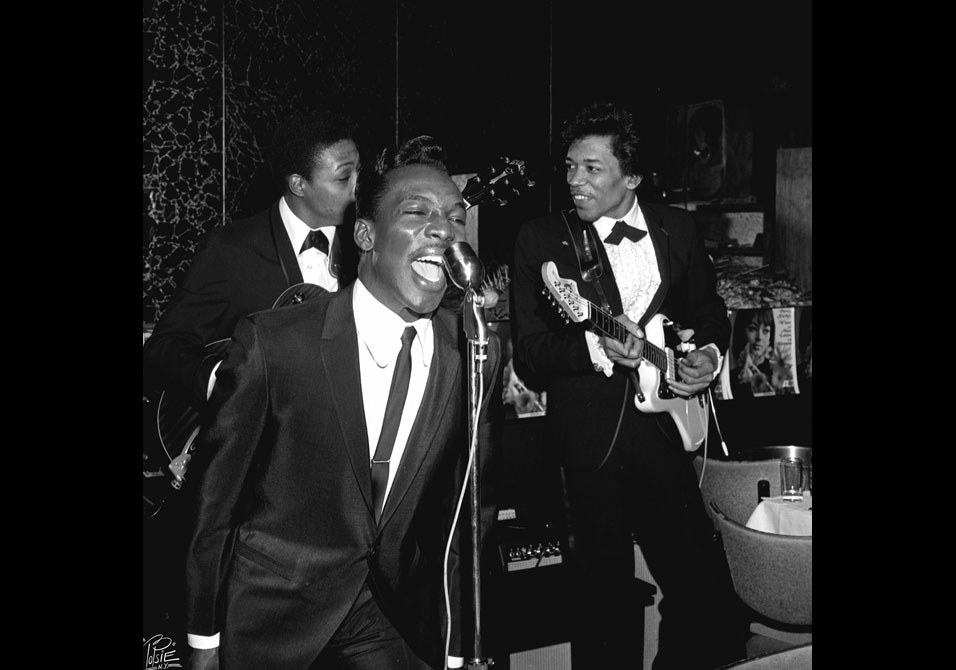
- William Randolph, 'Wilson Pickett & Jimi Hendrix', a splendid rare 1966 shot showing the young Hendrix resplendent in a natty tux and having a great time in Pickett's backing band, which is hugely incongruous with his later gypsy rock god image.

- Jean-Paul Goude, 'Island Life', three shots showing how the famous cover shot for Grace Jones' album was stitched together from a myriad of source images in order to create the arresting and somewhat alien statue portrait that she became famous for.

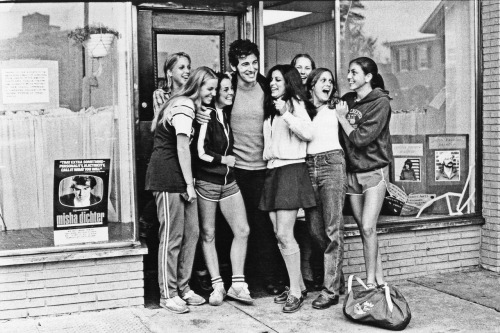
- David Gahr, 'Springsteen with fans', a charming 1973 shot from a New Jersey shopping street, in which a gang of teenage girls in their P.E. gear have coralled Bruce into a shop doorway and mob him for a photo. Everyone looks delighted, including Springsteen!

- Bob Whitaker, 'George Harrison - no way out?' from 1965, an archetypal representation of the perils of rock stardom, with the ever-inscrutable Harrison posing in front of a locked gate behind which hordes of desperate fans are thronging; above sits the ironic notice: 'way out' - certainly not for a Beatle.

- Laura Levine, 'Bjork as Venus', 1991 - this backyard portrait in Woodstock, New York, shows the Icelandic singer larking around with mates, wearing strategically-placed leaves and , in the final piece de resistance, extending her tongue to capture a falling raindrop. Reputation as the world's preeminent manic dream pixie girl secured.

- Gered Mankowitz, 'Marianne Faithfull', 1964, in which the 18-year-old Faithfull was photographed by the similarly 18-year-old Mankowitz, rocking the pert schoolgirl look in a London pub - a teenager flirting on the grown-ups' home territory. The record company was too nervous to use this shot as the cover for her first album, but it perfectly captures the youthful beauty and confidence that gained her entry into pop stardom.

- Bob Gruen, 'John Lennon, New York City', 1974 - these iconic building-top photos of Lennon in a cheap tourist vest have become amongst the most pirated rock photographs in history. Apparently Gruen doesn't care overly - he just makes his money from selling prints taken from the original negatives.

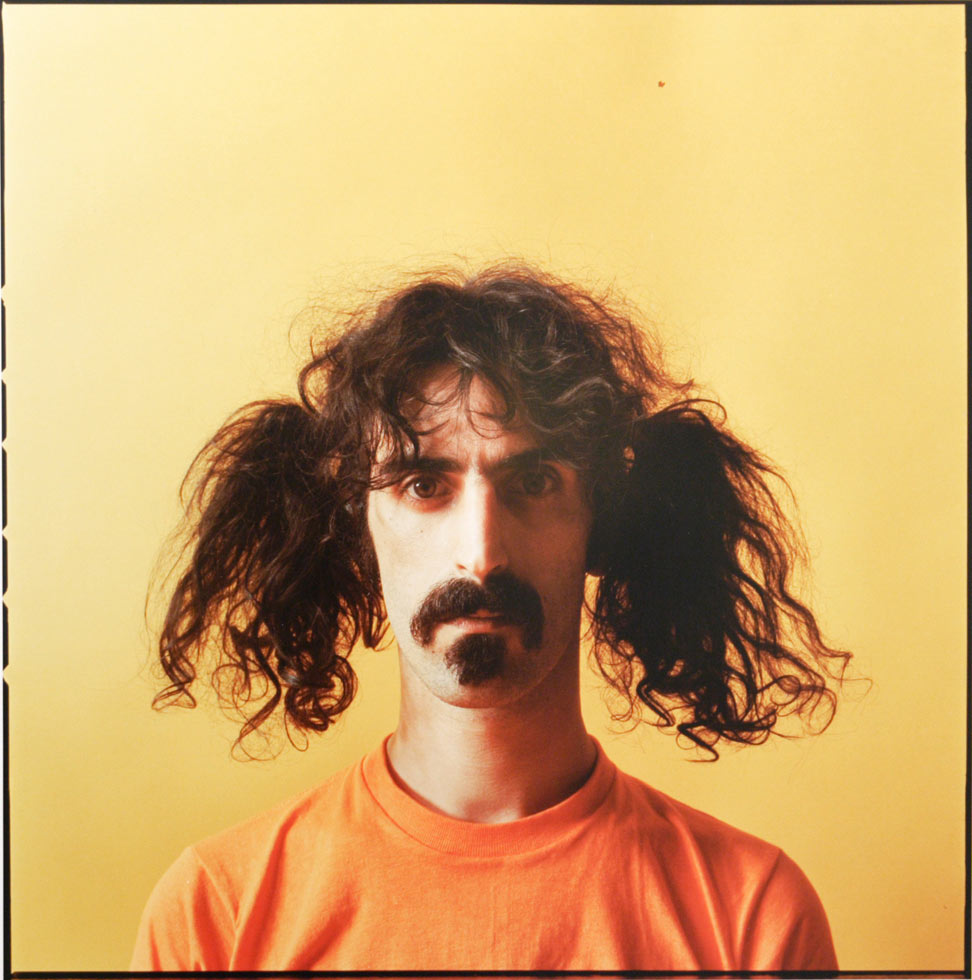
- Jerry Schatzberg, 'Frank Zappa, himself' - a droll 1967 portrait of a serious-looking Zappa rocking a pair of fetching pigtails, showing that he was never afraid of looking silly.

- Lastly, it's Bjork again - then boyfriend Stephane Sednaoui's video for her single 'Big Time Sensuality' from the album 'Debut' featured in two versions on matching screens - the released official version filmed on a flatbed truck in New York during the day, and an alternate rare edit filmed after dark. Such a performer!

16 September 2012

Sukita / Bowie :: Speed of Life


Yesterday I went for a daytrip to the Wairarapa with Former Flatmate Al with the express purpose of seeing an exhibition of 12 photographs. Sleepy Masterton may not sound like a likely destination for an art-related pilgrimage, but as it happens the people at Hedley's Bookshop have opened an art space next to their shop, and they're displaying prints from Speed of Life, a new limited edition book of rock photos from the career of the legendary David Bowie. The photos in the book and exhibition are from the long collaboration between Bowie and his friend, the Japanese photographer Masayoshi Sukita, which started back in 1972 in London during the heights of Ziggy-mania and still continues today. Sukita is responsible for many of the most iconic Bowie images of the past few decades, not least being the famous cover shot for 1977's "Heroes" LP, reproduced on the poster above:

Sukita's sleeve photograph, based like that of [Iggy Pop's] The Idiot on Erich Heckel's painting Roquairol, shows a wild-eyed Bowie locked in a rigid pose of serio-comic agitation, raising a flat palm as though he had just mimetically lifted the final mask of artifice from his face.
- Nicholas Pegg, The Complete David Bowie, Richmond (Surrey), 2000, p.231

The 12 exhibition prints range chronologically from the heady fame of 1972, Japanese shoots in 1977 and 1980, up to a more mature New York portrait in 2002, and illustrates the performer's myriad guises and, in the late 1980s during the clean-cut Tin Machine era, his spooky resemblance to David Beckham. The contact sheet for the "Heroes" cover is intriguing, showing Bowie deploying his mime skills in a range of seated poses, both dramatic and comic.

When I first heard about the book I was excited at the prospect and considered splashing out for a copy - but that was before I heard it was $1000! There are only 2000 copies worldwide, all signed by Bowie and Sukita, and the display copy at the gallery was fascinating and beautifully produced - the sort of book that you have to don little white snooker steward gloves before you handle it. The photographs were also signed by both men and were offered for sale at a mere $3950 each. Perhaps I should check my Lotto ticket.

The shop has a long-standing relationship with British rock publishers Genesis, which has led to Hedley's being given the rights to market Speed of Life in both New Zealand and Australia. Sukita even made an appearance at the gallery, telling journalist Tom Cardy that Bowie must have soaked up some Japanese influences in his many visits:

I'm sure seeing the Kabuki shows while he was in Japan gave him some inspiration. He also liked Kyoto very much, and I believe the song in the Heroes album called Moss Garden was written after he visited Saihouji temple in Kyoto, which is commonly called a koke or moss temple.

It was my first visit to Hedley's, and I was very impressed with the range and quality of its inventory. Frankly, I didn't expect to find a bookshop of that quality in a quiet country town like Masterton. With the addition of the art space and an interesting roster of small exhibitions (one on Ans Westra is planned soon), Hedley's helps to make Masterton a destination for weekend trips out of the capital. Take in a movie at the old Regent Theatre just down the road too, while you're at it. Probably best not to anticipate a bustling nightlife scene if you stay over though.  

Bowie I Sukita / Changes
HedSpace Gallery
150 Queen Street, Masterton
4 September - 6 October 2012

See also:
Video - "Heroes" (Live vocals on Top of the Pops, 1977)
Review - In the Lair of the Goblin King (Bowie in Labyrinth)
Photos - David Bowie doing normal stuff (incl. Sukita shot at 1/25)